Showing posts with label Conferences. Show all posts

Tuesday, August 22, 2017

Little Libraries, Big Ideas


It's something that's been apparent to me almost my entire career: little libraries have just as many - if not more - big ideas as do big libraries, but our budgets and personnel constraints make it so that we have a hard time getting the word out. I remember distinctly attending ALA Annual in DC back in 2010, walking over to have a conversation with someone at the Dark Horse Comics booth (we'd emailed before, and I wanted to say hi in person, and then later overhearing a remark about how cool it was that librarians were adding comics and graphic novels to their collections. I was flabbergasted. I'd been in charge of a graphic novel collection for most of my career - probably about 6 years - at that point. How was it that people thought libraries didn't do that thing?

And that's not the only instance I've seen in the 14 years since I started my first job in a library. Necessity sometimes truly is the mother of invention, so when your choice is between some fancy new expensive thing and keeping the lights on... you get creative. Small libraries - particularly small public libraries from whom I've shamelessly stolen ideas for years - are hot beds of creativity. Gaming in libraries. Maker spaces that go beyond a 3D printer. Outreach at places you'd never expect it, like a book club that meets in a brew pub. Art shows. The list goes on and on.

Now I need you to bear with me as I try to make this next point, because I'm not exactly sure where this will end up. I know a few things, though. I know that the cost of attending conferences, even smallish local ones, is cost prohibitive for too many people. Further, there are only so many slots for online presentations. I know that a lot of you are going to talk about the amazing connections you can make and enhance when you go to conferences in person, and you're not wrong. I've spent literally thousands of dollars out of my own pocket over the last 5 years to attend conferences, so I know. But I also know that my situation isn't common and not everyone can afford to do what I did.

Further, what about publications? I've tried to make LtaYL a bit of a platform for sharing ideas and innovation. There are plenty of other publications that do the same - The Journal of Creative Library Practice and In the Library with the Lead Pipe come immediately to mind. But what about the people who are so busy keeping their libraries open and running that they have no time to write?

It's hard to think about the kinds of things we're missing because of the disparity in finances between different kinds of libraries. And let's be clear: this isn't just a problem of academic and public libraries. Think about the teeny museum libraries that are run by curators who are also the librarians. Think about the small corporate libraries that have one librarian splitting their time between multiple locations. Think about librarians who work solo in the libraries of small city hospitals. What innovations have they dreamed up that could solve major problems at bigger libraries?

This isn't the first nor will it be the last time I discuss this problem, but it's gotten so much more frustrating lately. Admittedly, part of it is because I see big name/big school libraries getting lauded for doing things those of us at smaller libraries have been doing for years, and it stings. It really stings. Beyond the selfish aspect of this, though, is the fact that we really are missing out on some amazing ideas.

So, how can we solve this problem? Scholarships are good, but don't go far. Can we get more committees - particularly committees that are part of national organizations - to go digital? I'm not sure how to answer this issue, since my own solution was to dig into my own bank account. So, really, what ideas do you have?

Tuesday, March 28, 2017

All the Hugs and (Sometimes Problematic) Social Justice: Preliminary Thoughts on ACRL 2017


I'm sure there's a better way to organize my thoughts about attending ACRL in Baltimore, but chronologically seems the best way right now:

Wednesday, March 22.
First thing I did when I got to Baltimore was to head straight to the Critlib Unconference. And the first thing I did, after getting registered and finding a place to sit, was to hug someone I adore.
Seriously, the best thing for me about big conferences is the social aspect. Yes, there's the learning. Yes, there's the exhibit floor and connecting with vendors. Yes, there's the sightseeing. The thing is, I can learn more easily in the comfort of my own office or apartment; I can connect with vendors via email or on the phone; and I do better sightseeing when I'm not trying to fit it in between sessions. For me, conferences are all about the people.

If you were unable to attend, the Critlib organizers set it up so you could still benefit from the conversations. Attendees took notes and uploaded them to some Google Docs linked from the Program page on the website for the 2017 Unconference.

Sessions I attended:
  • Neoliberalism and Libraries
  • Intersectionality
  • Challenging Whiteness
  • LIS Education/Mentoring
There were so many great moments, like when I learned the term "recovering racist" (like recovering alcoholic, you're never 100% recovered) or when someone went on a long rant about how our classification systems are an example of white supremacy. I walked away from these sessions wishing I had some practical next steps I could take, but I did a lot of learning and listening so I'm well satisfied with the time I spent. Highly recommended, if you ever have the opportunity.

I skipped the opening keynote in favor of getting registered and settled in my hotel room, and then headed back to attend the opening reception. I have to admit that I mostly attended this to get some free eats, and once I'd filled my belly with hummus, fried mac & cheese balls, and a very yummy salad, I headed out for more socializing. The Alewife Gastropub was everything I'd been promised, and we had a great time hanging out and drinking yummy beer.

Thursday, March 23
The first thing I did on Thursday was to attend my own panel, “Library Leadership and Gender: Expectations and Lived Experiences." There was a lot of talk on the session hashtag, #libleadgender, and the room was pretty full, but the best part of this for me was how interactive the session was. We wanted it to be a conversation, and that's exactly what we got. The article that Michelle Millet and I wrote was intended to be the beginning of a conversation, and we were both absolutely chuffed at how well it went. Being nice shouldn't be a requisite for leadership, nor should it be a prohibition.

Next, I attended "Resilience, Grit, and Other Lies: Academic Libraries and the Myth of Resiliency." In a nutshell, the panelists (Angela Galvan, Jacob Berg, and Eamon Tewell) showed us that this false narrative makes it the individual's fault, and not the system's, because if the individual fails then they weren't resilient enough. 
After that was Roxane Gay's keynote. Wow, wowee, wowzers, did I love this keynote. This is my third ACRL, and I didn't think anything was ever going to top Henry Rollins' talk in Indianapolis. There have been other great keynotes, at ACRL and ALA, but Henry Rollins' had us all halfway in love with him. And Roxane Gay absolutely blew him out of the water. She knew her audience, too, as was evidenced by her joke:
Gay spoke to us about how she doesn't want our guilt or our shame, but instead she wants our fight. She also spoke to how there is no high road with the current administration, so we need to go "subterranean." I was so charged up that I was a little in tears - this was the kind of hope giving moment I needed from ACRL. The line on which she ended both gutted me and recharged me for the coming fight:
As empowering as her speach was, the Q&A was just as disheartening. April Hatchcock getting up to show (and these were her exact words) "her little black face," made up for some of it, but it was still kind of a Nice White People Trainwreck. However, I and others already critiqued the way people talked to Roxane Gay, extensively, on Twitter. Long story, short: a bunch of nice white people were looking to her for forgiveness and didn't get it - instead we got called to do the work.

After the keynote, I moved onto more socializing! I had lunch with the three other members of the Frye Leadership Institute, Class of 2012, who were at the conference. I hadn't seen most of them since 2012, so it was nice to catch up. I went to see a friend's poster, did some arts & crafts, met with my coteacher for the LITA class I taught last year & will be teaching again this year, hung out with other College Library Directors Mentor Program alums, and finally went to the Conference Chair's Reception. The reception was at the Peabody Library, which is a building that looks a lot like my idea of heaven (cathedral of books!).

Friday, March 24
My first session on Friday was "Who Steers the Boat? On women in a feminized profession," with Roxanne Shirazi, Emily Drabinski, and Nicole Pagowsky. A quick side note, that echoes something I think Emily Drabinski said - what was up with the organizers scheduling the heaving hitting feminist sessions first thing in the morning? Don't they know we need our sleep? Anyway, this session felt like the perfect counterpart to my own panel the day before - these panelists talked to us about the history of gender in our profession. The room was absolutely packed, and rightly so.

After that, I spent more time socializing. First, I caught up with a friend who was the one to get me to start presenting, and then had lunch with my CLDMP mentor (who will also be my co-presenter at the Maryland Library Association / Delaware Library Association annual conference in May).

After lunch I went to one of the most practical sessions of my conference - Verna Myers' talk, "What If I Say the Wrong Thing: Interrupting Bias in Ourselves and Others." I could write an entire post about what Myers said during the hour she had us in that room, and I can tell you she said a lot, but this post is getting a bit long already. Instead I'm going to urge you to look for her writings elsewhere. I've not watched it yet, but she also has a TED Talk. Two key takeaways that I had, that are immediately applicable:
  • Micro-affirmations. Notice people. Notice who isn't in the room and who isn't being included. Notice the time of day and day of week when things are being held, because it might be leaving people out of the conversation.
  • Acknowledge and interrogate your biases. We are all biased. It is literally in our genetic make-up to make snap decisions, but we can expand our comfort zones if we are intentional.
After Myers' talk, I finally took time to walk around the exhibits floor. I also managed to fit in more socializing while walking around, and I also picked up some swag for student contest prizes. Also picked up some chocolate.

Next up was Nicole Cooke's invited talk, "How would you like to be remembered? Expanded your pedagogy and professional practice." Cooke spoke about how she's worked to integrate diversity studies at The University of Illinois at Urbana-Champaign. 
For those of you who saw me tweet a plea for someone to talk me down from the ledge because I'm once again considering a PhD, it was listening to this talk - and hearing about the impact Cooke is having - that has me thinking this way. And no, all the talk of (a) intellectual hazing, (b) where will I find the money, and (c) the job market, hasn't stopped me from thinking about it. Being able to help, and shape, the next generation of librarians is a big draw for me.

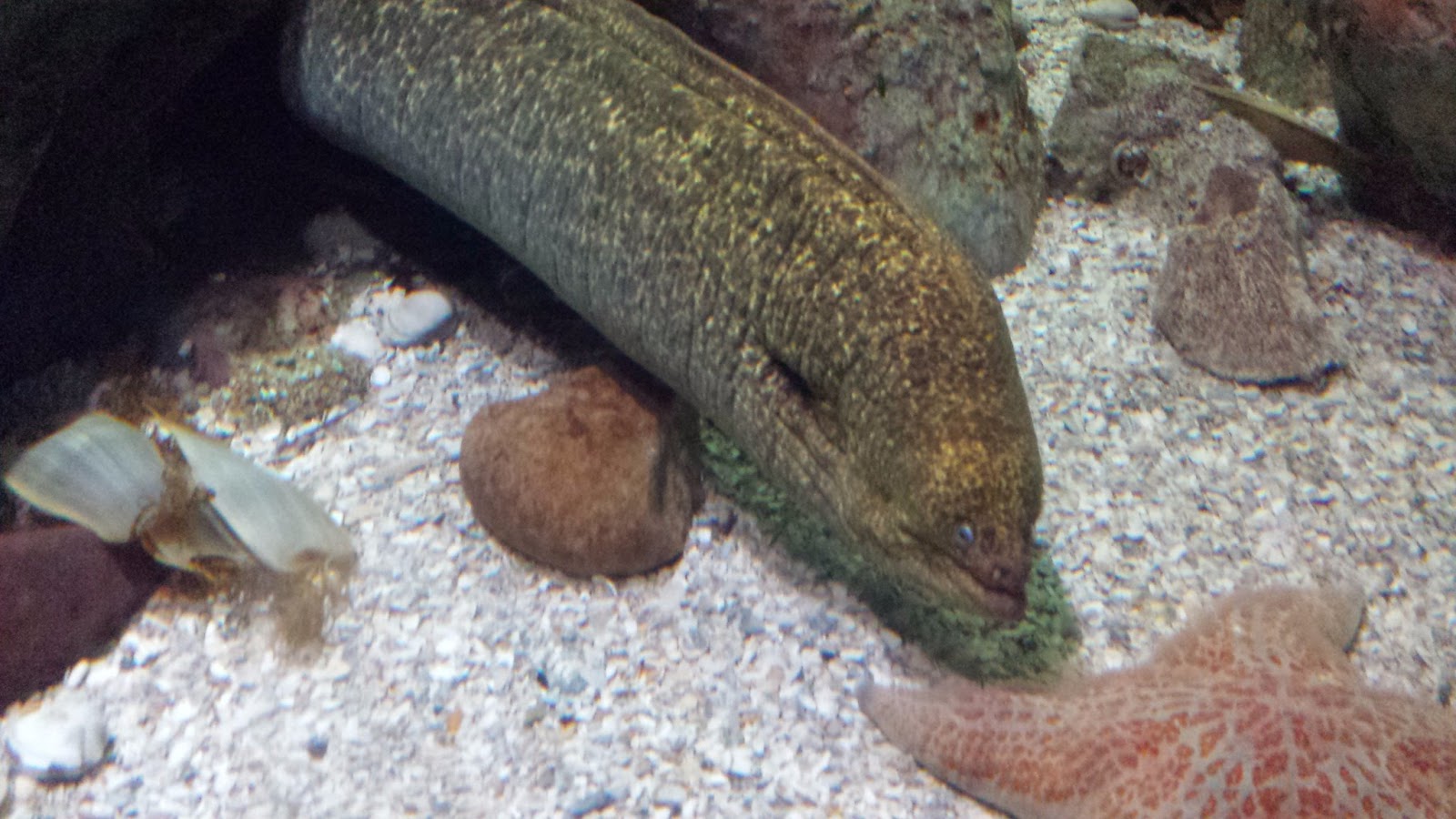
Up next was...? You guess it: more socializing. A small group of us went to the aquarium where I made a new friend, who I named Steve:


I also got to pet a ray, a horseshoe crab, and a jellyfish! And we decided to have dinner at the aquarium, where I ate one of the tastiest black bean burgers I've ever had.

Then it was on to the All Conference Reception at the B&O Museum. There were too many people. The drinks were hard to get, and I ended up drinking Heineken (the horror!) at one point. The band was a perfect nightmare of a bar mitzvah/wedding band that played everything from Journey - which was okay - to Whitney Houston - which was just so awful I can't even speak to how awful it was. And the acoustics in that space made their music even worse. If the Peabody Library was my idea of Heaven, then this place was definitely my idea of hell. The party was so bad that it ended up being funny and we had a good time complaining to each other about it.

Saturday, March 25
Yes, I was on a second panel. Yes, it was also first thing in the morning. But I didn't really mind, because "More Than Just Play: Board Game Collections in Academic Libraries" was a fun way to start the day. We had an amazing turn out for first thing in the morning on the last day of the conference, and people who came to our panel really seemed to have fun. Which was what we'd intended, since we set the thing up like a game of Jeopardy.

And after that, I went home. I did not sleep well and, since I drove to the conference, I didn't have to wait for a plane to take me. Oh, boy, did I need the nap I took when I got home.

How about you? What were the highlights of the conference for you, if you attended? If you didn't attend, which sessions looked great from the Twitter stream?

Thursday, July 23, 2015

ALA Annual Correspondence From a Small Town Librarian, by Chris Wilkes


As a librarian from a small, rural library, it is easy to become isolated from the larger library world. The “rockstar” librarians, big, urban libraries, and innovative ideas that are seen on the pages of Library Journal and American Libraries every month seem an otherness, something that I do not encounter in my daily work life. My perception of this otherness pervades my view of the American Library Association itself. Although I am a member of ALA, I have a difficult enough time using its website, let alone understanding the many divisions, roundtables, and committees. Besides bringing back new ideas to my library, I had hoped my attendance at my first ALA Annual would give me a clearer picture of the library community and my place in it.

For the most part, the conference shattered my perceptions about this otherness. I found attendees and vendors approachable throughout the conference. I met a couple of LJ Mover & Shaker’s and even met a former Executive Board member of ALA when both of us were resting our feet. It was those moments where I heard another attendee say they had difficulty marketing their programs or they were running successful programs on no budget that gave me most confidence that I was not on an island.

In a couple sessions, I did perceive a divide between larger suburban and urban public libraries and smaller libraries. I attended one presentation talk about their large library system that had more money for marketing than my entire library’s materials budget. There also seemed, from the sessions I attended, to be a lack of understanding that buying new things can improve your library’s circulation and attendance. [Editor’s Note: This is not just a public library thing. Lots of us forget that our perspective isn’t the only one.]

Walking away from ALA Annual, I still sense a certain separation between myself and the larger ALA bureaucracy. Even though most meetings were open to members, I do not feel that my attendance at these meetings would have changed my opinion. At the NMRT 101 and RUSA 101 sessions, the message was to get involved. I’ve taken this message to heart and I hope to join a committee (or at least attempt). I cannot really complain about the organization if I only play a peripheral role in it.

One of the unexpected outcomes of attending ALA was that I have begun actively to question my role within my library. I think this self-reflection started when I was asked in an Unconference to state my preferred pronoun. I was immediately confronted with identity. As a white, male librarian, I very rarely thought about how my gender, racial, and social background can affect a reference interview or staff interaction. To some degree, I had thought such conversations were academic and were separate from my role as a librarian. I hope this new awareness will allow me to recognize barriers in my daily interactions with patrons and staff.

Similarly, I began to question my library’s role within our community. My community has a very small minority population and there is almost no visible LGBT presence, but my library could do more to serve their needs. I doubt these thoughts would have occurred to me within my small, conservative community without being a part of ALA Annual during Pride weekend or without seeing the praise that the Ferguson Library has received. My library has already taken steps to start adding more LGBT books for all age levels in the week since I’ve been from Annual.

My first ALA Annual left me both exhausted and rejuvenated. Besides bringing several new, innovative teen and adult programs as well as new marketing strategies back to my library, the most important outcome of my first ALA Annual is that it challenged my perception of my role in the library community.


Chris Wilkes is the reference librarian at the Tazewell County Public Library in Southwestern Virginia. Despite having a robot for an avatar on Twitter, where he tweets as @irobotlibrarian, he promises he’s a really real person. Maybe.

Tuesday, February 3, 2015

Revisiting Big Conferences

Jealous of other tweeters? Yes. Yes, I am.

As I've been watching the Twitter back channel for the American Library Association Mid-Winter conference, I've been experiencing a ton of jealousy. So much so that I feel the need to retract a lot of what I said in the third post I ever wrote for this blog, "Why I Went to ALA Annual (But May Never Go Again)."

I still stand by what I said about this conference not being the be-all-end-all of librarianship, but I've come to realize big conferences can be a fantastic experience if you know what you're doing. Here are the things I always seem to get out of bigger conferences like ALAAC and MW, and ACRL:
  • Meeting Online Friends In Person. This is the biggest thing I get out of big big BIG conferences. Sure, I've met up with people I knew from online at small regional and/or specialty conferences, but the bigger the conference the more people I end up seeing. 
  • More Options for Learning. ALA usually feels a bit more public library focused, but there was still plenty to be learned. And, if all else fails, the conversations I fall into while eating lunch or strolling down the aisles of the exhibit floor give me just as much if not more than actual sessions,
  • Bigger Audiences. As you may have noticed, I tend to have strong opinions about libraries and higher education. I love how broadly my blog is read these days, but sometimes there's nothing better for getting yourself heard than actually talking at a conference. 
Sure, there are plenty of drawbacks to attending national library conference. The expense of registration alone can be enough to make you second guess yourself, and then there's the travel and the hotel and the meals and and and... But, really, other than that first one that inspired my early cynical post, it's been worth it every single time.

How about you? What do you think of the big conferences?

Tuesday, February 25, 2014

On Fangirling and Chilling

I've been sitting on the idea of this post for a while because I don't want anyone to be insulted, but I keep coming back to the idea so here it is: my thoughts on fangirling/fanboying out in the library world.

I'm closing in on the eleventh anniversary of my MLIS, and because I become more opinionated the longer I'm in this profession, I spout off from time to time. (And by "spout off" I mean "put some thought and even some research into my ideas, write about it, let it sit for a bit, edit it, and then publish it on my blog.) Because of this and a few conference presentations, despite my protestations otherwise, people are starting to pay attention to me. Not that people scream and chase me when they run into me, even at conferences, but there have been minor moments of fangirl/fanboy floppy happy freak outs. I try to calm people down, because really I'm no big deal - put my pants on one leg at a time and all that - but also because it's a little disconcerting. I supposed I could start making people kiss my imaginary ring, but that seems a bit excessive.


I decided finally to write this post because I've felt those fangirl feels. Sweet Baby Buddha knows I've been nervous meeting a couple of my librarian heroes. A couple of friends were made responsible for keeping me from freaking and fangirling at a recent conference, because I wanted to keep cool and to treat my heroes like people - because that's what they are.

The point is that I'm trying to scale back my own floppy happy freak outs because I have now been on the receiving end of them. I love that people appreciate my work. Hearing "I came to your presentation because I love your blog" put a grin on my face that lasted for over an hour. But people telling me I'm famous? Oh my, no. I might have achieved some notoriety with this blog, among a subset of librarians, but that's not famous. I'm really just this weird, thoughtful, occasionally introverted, wisecracking person.

Let me be clear: it's not that I'll get all snobby if you get floppy happy freak outty when you meet me, it's just I'd rather someone say, "Hey, wanna go for a beer? Coffee? Can I chill with you after this panel?" And because we should be the change we wish to see in the world, that's what I'm going to do from now on. Inside I might be all

Source
But outside I'll be more like

Source
The thing is, I know I enjoy learning that people love my blog, but I'm happier still when it's a chill conversation. I've learned that if I act normal sauce, people are more likely to talk to me. And so I'm passing my learning onto you.


(Thanks to Jake Berg for the idea of using that Wayne's World clip.)

Tuesday, January 28, 2014

Over the River, and Through the Woods: On Attending Midwinter

"Snowy Philly"

I'll admit it: I almost didn't attend ALA Midwinter, even though it was held just a little over an hour from where I live. You see, the entire week leading up to the conference, I participated in the in person seminar part of the College Library Directors' Mentor Program. I was worried that I'd be peopled and library talked out. Besides, I knew I'd be missing my old lady kitty by that point. But I let a combination of factors win me over: a good friend was presenting as part of the GamerRT Forum, a lot of people I admire were going to be in a panel discussion with a topic close to my heart, and finally there's the fact that someone guilted me into going.


No exaggeration in that tweet, by the way. I really did have an amazing time at midwinter. I was surprised to get so much out of the conference, since the one time I went to ALA Annual was a mixed-emotions kind of experience. Now that I've had a couple of days to ruminate, I've come up with a list of reasons why I liked ALA Midwinter 14 so much better than Annual 10:
  1. Midwinter is a much more manageable size. Thus far in my career, my favorite library conference is definitely LOEX (highly recommended if you can go, and if you get a paper accepted you are guaranteed a slot - something I've been fortunate enough to do twice), and the times I've been the total attendance was somewhere between 400 and 500 people. Compare that to ALA Annual, which attracts upwards of 20k attendees.
  2. The smaller size meant I was able to have deeper conversations with people. Dinner with the libtechgender crowd after the panel was fantastic. It was interesting to participate in a more personal discussion of gender issues in the work place.
  3. There were sessions that interested me personally and professionally, and that I felt would give me real takeaways. (Confession: I sometimes feel like a lot of conference sessions are prompted more by a need to put something in the tenure portfolio than a genuine desire to communicate findings.)

  4. Really, though, the best thing was the people. Twitter encompasses so many of my professional contacts and so much of my personal learning network, and I feel like I met and/or hung out with about half of my Twittersphere in the space of 12 hours.


So there's my ALA Midwinter story. A fantastic conference experience, and I wish you the same the next time you decide to go out of your library to engage with the rest of our profession. 

Anybody else who attended want to chime in?

Thursday, November 21, 2013

Zen and the Art of the Conference Proposal, by Valerie Forrestal


Your first year as tenure-track faculty is an odd one. You’re not expected to publish right away, but it’s encouraged that you keep your CV active by adding to it in one way or another. Given the amount of time you spend acclimating to a new workplace during your first year (anywhere, not just in academia), you don’t necessarily have the time or the connections to do anything major. Often you’re expected to spend that first year choosing future research projects, and starting to design your research studies and maybe collect some data if you’re lucky. Sometimes, if you’re like me, you were hired to work on a specific project, and will spend much of your time tackling minor practicalities like building a website from scratch and migrating the entire former site’s content to it. Pish posh.

This forces you to be a bit creative with adding lines to your CV. I’ve looked for limited time and energy-commitment obligations, like less formal writing projects and talks at local chapter meetings. One opportunity I stumbled across on one of the CFP blogs I follow was a call for conference proposal reviewers. I’ve acted as a peer reviewer in the past, so it seemed like a good opportunity for some professional service.

About halfway through the 20-or-so proposals assigned to me for review, I realized that this was much more than just a line on my CV. I’ve submitted many conference proposals in the past (a handful of which were actually accepted,) but being on the other side of the submission process gave me some useful insights for the future. (For the record, the conference was not library-focused, and it was a blind review process, so I feel ok about talking about it publicly.)

First, I shouldn’t have to say this, but based on many of the submissions I reviewed it warrants a mention: Follow. The. Instructions. You’ll read this advice a lot in posts about applying for jobs, but it goes for pretty much any official process in the professional world. Sometimes you think can skip steps. Maybe you know someone. Maybe you’re a big name in the field. Maybe you presented last year. Well, I can’t see your name and I wasn’t at last year’s conference, so do us all a favor and complete all the fields in the form. If I don’t need a certain piece of information I’ll skim over it. Better safe than sorry.

Here’s another piece of advice that comes directly from job application best practices: customize, customize, customize. Maybe you’re submitting a similar proposal to several similar conferences. I don’t care. Take the time to tweak your proposal to at least touch upon this specific conference’s mission and theme. I know you have to put out a lot of proposals just to get a few acceptances, but try to make it feel like this conference is one you actually *want* to present at.

GradHacker recently did a post on Killer Conference Proposals, and while all their tips are good ones, I think their final tip is of particular importance: “Explicitly state an audience takeaway.” Of course *you* find your research interesting and relevant (or at least I hope so). But take a step back and think like a marketer. What are you offering presentation/panel attendees? So many proposals I reviewed talked exclusively about their own experience without in any way addressing why that experience should matter to anyone else. Is the technology you used attainably-priced? Are your assessment standards widely accepted? What kind of implementation time/resources did it take? I’ve sat through many presentations where the project discussed was fabulous, but I came away frustrated because the presenters made no effort to tell me how I could replicate all or part of it, or apply the knowledge elsewhere. Give me something I can use, or reserve this talk for a showcase or project update event.

My last piece of advice doesn’t really apply to a blind review, but I’ll mention it anyway. When I’m participating in an event, I make sure to publicize it throughout my own networks. I like to think this gives a person a reputation as someone who will actively work to help draw in attendees, and thus be an asset to future events.

If anyone else has been part of the conference proposal review process, please leave some tips in the comments! What causes you to reject a proposal outright? What puts a presenter on your good side right away?


Valerie Forrestal is the Web Services Librarian and an Assistant Professor at the College of Staten Island, City University of New York. Her education includes an MA in Media Production from Emerson College, an MLIS from Rutgers University, and an MS in Service-Oriented Computing from Stevens Institute of Technology. Valerie specializes in web development, social media, technology planning, and innovation in libraries and higher ed. You can find her online at vforrestal.com, vforrestal.info, or on Twitter @vforrestal.

Thursday, July 11, 2013

Libraries, the Universe & Everything – a Letter to a Younger Me, by Ned Potter

Source

Dear 25-year-old-me,

It’s January 3rd, 2006. Tomorrow you start your new job as a Customer Services Assistant at the University of Leeds Library, UK. The bad news is, you’ll be commuting every day to an entry level job on a ridiculously small wage. That’s what comes of having a humanities degree, eh? The good news is, you’ve found your calling. Here are some things to watch out for over the next seven and a half years.
(That’s the first major headline, by the way. You thought libraries was just a temporary thing, but it isn’t. Okay, read on.)

You won’t believe how much you care about libraries
Previously you’ve been fairly indifferent to Libraries. Pro-library of course, in a not-really-thinking-about-it leftie liberal kind of way, but you don’t really go to them much. Or at all. In fact it is people like you who libraries aren’t attracting but potentially should be – you’ll often think back to how you felt about libraries in 2006, so get an insight into what is realistic in terms of attracting new users.

Anyway, you will start to care about libraries a LOT. You thought you were going to segue into Careers Work from here, but it turns out library work is a lot more interesting than you’d ever imagined (a common theme among your peers, you’ll realise, in about 3 years’ time when you wake up and finally get online). You’ll love working in HE, you’ll really enjoy the contact with the students and being on the cutting edge of learning technology. But you’ll also end up caring about public libraries, special libraries, school libraries as well. Bafflingly, despite being inherently lazy and having had exactly 25 years of massive underachievement, you’ll care about libraries so much it’ll cause you to work really hard, including sometimes in your own time, at home! Imagine that.

You’ll care about librarians even more
Between first getting online in 2009, and finishing your book in 2012 (I know! WTF, right?), you will invest an enormous amount of emotional energy in libraries, and after that you’ll settle down a bit and take a step back. But what never dims is your passion for librarians. Or more broadly, information professionals – and professionals here refers to anyone in the profession, NOT people with degrees. (Don’t even get us started on that.)

The best thing about librarianship, by far, is the community. Info pros are defined by their kindness, their willingness to help and to share, their sense of fun, and their love of gin. (You don’t like gin at this point – sort yourself out and start drinking G&Ts instantly. This letter will seem more insightful and entertaining the more gin you drink.) [Editor’s note: This guy is clueless. Real librarians drink vodka. Or bourbon.]

Going to library conferences is FANTASTIC. Particularly ones around New Professionals – new profs are generally defined as people who’ve entered the profession within the last 5 years, and even in 2013 when you’re most definitely OLD, you still love the new prof events the most. The energy, the optimism, the positivity! It’s great. Because fundamentally, it turns out that you can seek out the people who have the same outlook on the profession as you do – the world doesn’t all think like the people in your office. And that’s a great thing. Twitter, which hasn’t been invented yet (buy shares in it if you can) is going to allow you to be part of a network with likeminded people who work in the same profession as you, and to interact with them every day – you won’t believe how brilliant that is.

You’re going to have to do another Masters
Sorry about this. But it turns out – we really should have foreseen this – that a Music Masters doesn’t really lead to increased employability. And there’s a ceiling in Librarianship – around the second or third job you get – beyond which it’s very difficult to progress without a Masters in Library and Information Management, or similar. So as soon as you secure your second job in Libraries, in 10 months’ time, you’ll agree to do the Masters via Distance Learning. And though you don’t think the degree itself is up to much (and will later grow to dislike being complicit in a system so obviously flawed) you’ll be glad you have it because it’ll allow you to progress to what is known, irksomely, as a ‘professional post’. Professional posts pay quite well, so although you’re on naff-all money now, you’ll be fine in the end.

The upside of all this is you’ll be a Master of Science! Given your Science GCSE grades (2 Ds) you’ll find this hilarious. Take that, Mr. Mallaband the Chemistry teacher who said you were the most frustrating student he’d ever taught!

You waited too long to get online
Half way through 2009, librarianship goes from your job to your vocation in a day, more or less. You go to the inaugural New Professionals Conference in London (turns out you love public speaking, which you did NOT see coming…) and it’ll open your eyes. One of the papers is given by Jo Alcock who, it turns out, is something of an online pioneer. In 2013 EVERYONE is online, but the migration was still happening back then. Jo’s talk about her blog and Twitter activity makes you think you might like to try something like that. Events which subsequently happen and which can be directly traced back to that decision include: getting dream subject librarian job you aim for all along, getting to travel to other continents to give presentations, writing that book, doing some consultancy for the Latvian Ministry of Culture… I know, right? Wtf!

(You’re probably wondering why 2013 you says American things like ‘I know, right?’ etc. Well, it’s sort of done ironically. But also not, really. Because you communicate in a very American way, generally. More than half the traffic to both your blogs comes from the US. You’re friends with lots of North Americans generally. You speak the same language. But also, you’ll learn over time that the right people will appreciate you – it’s okay to be yourself and lose some of your audience by saying things like ‘I know, right?’ because there’s enough people out there who’ll understand where you’re coming from.)

So really, the first two and a half years of your professional life were fine, but your horizons would have been a lot broader if you’d been online from the start – if only as a consumer of blogs at first, later becoming an active participant in the community. Knowing you are part of something bigger is a hugely powerful thing.

Twitter will be the single most important tool for your CPD
CPD means Continuous Professional Development. You will LOVE Twitter (the first Tweet will be sent 3 months from now), despite resisting getting on there for YEARS, even after starting blogging, because you were too narrow-minded to understand it. But Twitter will keep you up to date with what’s going on, give you a constant source of ideas and inspiration, and tell you about new tools to try. Without Twitter you wouldn’t have been able to get your current job, write your book; do anything good, really.

You’ll have quite strong views on what we should be doing in the profession
Your dislike of conflict has not gone away so this occasionally causes some stress when you’re saying things people don’t want to hear, but it’s nothing major so you’ll do it anyway. Because you’re passionate about libraries and librarians, you are vocal about what you believe to be important. This includes:
  • Communicating our value PROPERLY at every opportunity. Librarians can be backwards about coming forward, but this is no longer acceptable – we have to make it explicitly clear how we can help people do things better / quicker / cheaper / more efficiently or whatever it is. We need to talk BENEFITS, not features. We need to talk services, not content. As Stephen Abrams (you don’t know who he is yet, but you’ll love him) put it just yesterday in 2013, nouns (books, buildings, desks) can be cut, can be warehoused, can be replaced from other sources. Verbs (engage, serve, DO) are the impact that we as librarians provide, and that’s what will – hopefully – keep most of us in jobs.
  • Embracing informality. Libraries tend to communicate in a rather austere and formal way – this goes back to the need to be respected and taken seriously, to have professional integrity. However, it IS possible to be professional yet informal, and communicate more effectively. Approachability is so important to building relationships, and relationships are essential in librarianship.
  • Trying to inspire people rather than placate. Librarians and libraries are inherently quite cautious and have a massive in-built fear of offending or alienating anyone. This partly comes from the moral duty libraries have not to exclude groups or demographics. However, simply not offending people is NO LONGER ENOUGH. That’s why we’re in this mess. (Oh did I mention libraries are in a mess? Tomorrow morning at 9am, your first day, you’re officially stepping on to a sinking ship. But that’s not as bad as it sounds – it’s an inspiring challenge and it’s invigorating to fight for something you believe in.) To get more people to value libraries, we need to inspire people – and it is difficult, if not impossible, to inspire anyone if you’re catering for everyone.
  • Understanding that work-life balance is important enough that it should not be considered with reference to what ANYONE ELSE IS DOING. By which I mean, a lot of people in the library community seem to be sort of super-librarians who do EVERYTHING, which scares some info pros – but the only thing that matters is finding a work-life efficiency that works for YOU. Whatever makes you happy.  There are no standards by which any of us should judge if we’re doing ‘enough’ except our own. In other news, it turns out saying ‘no’ to things, even great opportunities, is absolutely fine. Never once will you really regret it. Also you don’t need to be a martyr to this profession. There are prominent voices online who would have you believe that if you’re not out protesting against library closures, you don’t deserve to be a part of the profession. This isn’t true. Everyone is different. There are still many things in your life much more important to you than libraries.
  • Libraries have always been product orientated, but now they need to be market orientated. Ah, marketing speak. You’ll try and avoid it, but it’ll slip in now and again. Libraries have always been about books – you want books, go to the library. That worked for centuries, but now the information books contain is available through myriad other sources. So being based around a product – the book – doesn’t cut it anymore. We have to be based around the market; to survive we need to provide what people need. This means listening, anticipating, being brave. Fear-based librarianship has a very short life expectancy.

Okay, this letter is far too long already. You need sleep before the big first day. You’re about to start a journey which will be several times more awesome than you could possibly anticipate. As of tomorrow, you’ll no longer be an aimless slacker, because you’re about to stumble into a profession that will make a man out of you.

Have fun!


Ned Potter is an Academic Liaison Librarian at the University of York, as well as a trainer and presenter. He tweets @theREALwikiman, blogs at thewikiman, and recently published The Library Marketing Toolkit.

Tuesday, May 7, 2013

The Long and Short of It, Part II: ACRL 2013, The Sessions

Source

So, last week I shared some of my observations about ACRL 2013. At that point, I was planning to make this follow up post about individual sessions - highlighting the good, the bad, the tools. While I did catch a few dud presentations, I also attended a lot of great ones - for instance, the one where the presenter was talking about using Google Earth as a language learning tool was particularly fascinating. However, the idea of talking about each session I attended no longer seems appropriate. Maybe it's because I went to and presented at LOEX in the meantime (yes, I know - too many conference presentations). Maybe it's just laziness. Regardless of the reason, I think I'd rather talk about how I approach attending sessions instead of the sessions themselves.

You see, at this stage of my career, I've done and seen and thought about a lot of things in this field. Not trying to affect a "been there, done that" attitude, but ten years is a long-ish time. I do still encounter sessions that cover topics with which I'm completely unfamiliar, but that's fairly rare these days. Instead, I usually range between having some awareness to having lots and lots of knowledge on the topic being discussed. Does that stop me from going? Well, it used to, but it doesn't anymore.

Now I go hoping to pick up a few new tidbits, but also hoping to be able to add to the conversation. Here are some recent examples:


All of this is to say that I no longer go to sessions hoping to get something out of it. Not in a overweening, know-it-all, show-off-y kind of way, but but nowadays I mostly go to sessions hoping to give something back, hoping to add to the conversation. How about you?

Tuesday, April 30, 2013

The Long and Short of It, Part I: ACRL 2013


I'll admit it. I had low expectations going into this. I've written in the past about how I'm not a fan of big conferences. I mostly submitted my roundtable proposal so I could have an excuse to go hang out with my roundtable co-leader and to hear the Henry Rollins keynote. And if those two things had been all I got out of attending, it would have been worth it. Ayanna *is* pretty awesome, and Rollins was even better than I'd anticipated: he gave me a catch phrase I'm adopting for my own. But that wasn't all I got.

Below you'll find the first part of an overview that I decided was too long to be just one post. Part II will follow next week.

Battle Decks

From the program: "Battle Decks is an event where speakers present PowerPoint presentations they have never seen before. Some people call it 'PowerPoint karaoke.'  It's fun for participants and audience members alike and helps hone your presentation skills. A few audience members will be asked to compete. Are you game?"

I went mostly to humor my friends. The event itself held no appeal for me - seemed too "cool kid" for me. Wow, was I wrong. It's hard to describe what it was about Battle Decks that made it so fantastic, but when someone is presented with a theme and a random set of slides (random and hilarious) and is then expected to give a speech that makes sense? Hilarity ensues. I'm proud to say that this year's winner is a past contributor to this blog.

Our Roundtable

The roundtable I co-lead was "'You Have Stephen King? Really?', Or, The Role of Popular Reading Materials in Academic Libraries." The best thing about it, in my opinion, was that people actually came. Heck, we had to pull an extra chair over. The conversation was great, as well. Even though I was one of the people leading the discussion, I still got some new ideas out of it.

Exhibit Floor

Not as big as the exhibit floor at ALA, but still pretty darned huge. It was still big enough that I didn't get to visit all the booths. Actually, I was confused (still am, to be honest) about why the exhibit floor wasn't open for the entire run of the conference - or at least for more of it.


Well, that's as good a stopping point as any. Next week I'll write about the sessions I attended and some of the things I gleaned. For those of you who were able to attend this, or previous, ACRL conferences - what was your favorite part?

Tuesday, April 16, 2013

Cults of Librarian Personalities


I went to ACRL 2013 last week, and I'm still thinking thinks about the conference in general. I plan to write a general review/overview of my experience, but I want to take my time with it and get it right. In the meanwhile, there is something from the conference that keeps coming to mind, and that I want to address right away: the Rock Star Librarian / Cults of Librarian Personalities phenomenon.

In addition to nabbing many free pens... I mean, talking to lots of vendors on the exhibit floor... I attended sessions, as one does at conferences. These ranged from very small, such as the roundtable I co-lead, to very VERY big, such as the keynote given by Henry Rollins (I have a huge intellectual crush on him now). At least one of the sessions was something lead/given by someone I consider a Big Name in Libraries, a Rock Star Librarian, an inspiration for a Cult of Librarian Personality. Normally I avoid these people, preferring to spend my time listening to and talking with people who are doers instead of thinkers (thanks, Andrew Whitis, for giving me the perfect phrasing for this).

So why did I go? How did I end up experiencing a Cult of Librarian Personality first hand? Because, despite thinking that particular Big Name is an utter tool (judging from a few brief personal interactions we've had), I also think that Big Name is utterly brilliant. I have read articles and books and blog posts written by Big Name. Heck, I bought a copy of a book by Big Name for myself because I liked it so much I wanted to be able to write in it, guilt-free. The thing is, even though Big Name might be a Big Tool, Big Name also makes me think. I know I can take the ideas I get from Big Name, smoosh them around until they fit my circumstances, and make them my own.

So, no, I'm not a fan of the Rock Star Librarian mentality, but I know those individuals can serve a purpose in this field - at least in my life, they do. They all influence my professional practice, whether it is to avoid making what I see as their mistakes or to moosh their ideas to fit my context. I say, let the Rock Star Librarians rock on. I'll be over here, continuing on in my indie pop star sensation/minor success way, and be happy doing so.

But what about you? What do you all think of this phenomenon? Do you avoid Big Name Librarians at all cost? Seek them out because you love to hate them? Have a true fondness for one or more of them?

Tuesday, May 22, 2012

A Little Bit of This, A Little Bit of That, Or, How I Picked Sessions at LOEX

I'm still mulling over what I want to write about the presentation I gave at LOEX this year. It went well, for sure. People laughed at my jokes and asked the right kinds of questions when I was done, so I'm counting it as a success. But that's a post that's still percolating. Instead, I'm going to tell you about something else that I did at LOEX.

This may come as a surprise, since most of what I see written about conferences is about networking while there, but I attended some sessions. For me, the whole point of attending conferences is professional development. I know, you're shocked. Bear with me, though. I want to explain how I pick sessions because I was clueless about conferences at the beginning of my career.

At LOEX...

  1. I attended some sessions that will benefit current projects. For instance, we're starting up an online presence - blended learning mostly - so at LOEX I went to a couple of sessions about converting and updating online information literacy courses. The biggest thing I learned from these sessions is that I've already done my homework and that I'm ready to do this thing. 
  2. I also picked some that could help with future projects. Chris Sweet, of Illinois Wesleyan University, gave an amazing presentation about how he teamed up with a service learning course to integrate information literacy. Sweet's assertion is that service learning and information literacy have the same end goals. This session was one of the best I attended, and his ideas got me so fired up that I made an appointment for next week to talk about Sweet's ideas with our director of service learning.
  3. Finally, and this is the thing I always neglected in the past, I went to a couple of things just for the fun of it. I attended a session about graphic novels and I watched the lightning talks (I'm not sure I could give an entire talk in 7 minutes, so I wanted to see others try it). 

Yes, I make sure to go to sessions that help me develop as a professional, but all work and no play make Jessica a dull librarian, so I make sure to have some fun as well.

How about you? How do you pick sessions at conferences? Or, if you've never been to one, what kinds of sessions do you think you'd like to see?

Wednesday, December 21, 2011

Comfort Zone, Shmomfort Zone, or The Benefits of Presenting at Non-Libr* Conferences

I presented a paper at the Midwest Popular Culture Association / American Culture Association (MPCA/ACA) annual conference this year. My talk was titled   "Zombies 101: Humans vs. Zombies at a Small Academic Library," and it was part of the Libraries, Museums, and Collecting panel. The kinds of topics that were presented at that conference varied a lot, from the highly esoteric to the extremely practical. Presenters ranged from undergraduates (they have a fab undergraduate paper competition) to well established scholars. It was a bit overwhelming and intimidating at first, but overall I had an amazing time.


The best part of it, in retrospect, was stepping outside of the library science bubble/echo chamber. Yes, I was part of the library-related panel, but that was only one part of one day of a three-day conference. During the course of the entire thing, I talked to scholars who study the "Harry Potter" series, representations of disability in popular media, parenting magazines, and so on. One particularly good talk I attended was all about how the presenter uses the "Hunger Games" series to teach undergraduate teacher candidates about class and social structure. Most importantly, the MPCA/ACA annual has a mostly non-librarian audience. This gave me the opportunity to talk about what I'm doing and why libraries aren't just storehouses for books on college and university campuses to people outside of Biblioterra.


I don't know if I'll go back to that conference any time soon, since what I'm working on now doesn't quite fit topic-wise. However, there are other non-libr* presentation opportunities out there that might suit. Please don't misunderstand me. I'm not advocating a complete abdication of library science related conferences. For instance, I submitted a proposal to LOEX (wish me luck!) for the 2012 conference. I'm just saying that it's worth the time and effort to move beyond libr*, especially if we want to be seen as relevant.


What do you think?