Showing posts with label On the Job Learning. Show all posts

Tuesday, January 9, 2018

On Still Not Knowing Everything


Since I just closed out my first six months of my not-so-new-anymore job, I figured it was time to revisit the idea of knowing that I don't know - something I wrote about almost exactly 5 years ago as I was about to start my first job as a library administrator. My mind was boggling at all that I had to learn, and the truth is that I hadn't even imagined half of all that there was to know.

This most recent job change was easier in some ways. I made a lot of mistakes as a new library director... mostly dealing with people issues. Learning that I couldn't think aloud anymore was hard. Learning to ask questions in a way that the staff understood it really was just curiosity with no subtext was even harder. Hardest of all was learning to look at the entire context of an issue before trying to come up with a response. So starting my second job as an administrator was smoother because of all my past missteps, but that prior learning hasn't actually made it easy.

Although I'd worked at a two year institution before, I've never worked at a public institution of higher education. Further, although we are relatively small at just under 6000 FTE, this is also the biggest school that has ever employed me. Another big change is the size of the staff - I have 17 people working for me. I have learned a lot a lot a lot, but I'm still adjusting to all of this. And there is still so much more to learn.

Here's a list of what I KNOW I need to do:
  • Experience all the ins and outs of our budget cycle;
  • Sit down with as many of the rest of the faculty as possible;
  • Live through the rest of our strategic planning process and experience its ramifications;
  • Understand all of my responsibilities as they play out through the school year;
  • Get to know all the nuanced (or not so nuanced) differences between working at a small liberal arts college and a small-ish community college.

And that's just the stuff I know that I need to learn. At least once a week I learn something that I had no idea I needed to know, like how we handle email when someone leaves the institution or who to contact when I want to reserve a room in one of our new buildings. We all know, in theory at least, that we never stop learning, but it's so very different to be living it every day of my life. I love it.

Tuesday, August 8, 2017

Getting Up To Speed: First Month in My New Job


My first month in the new job is over, and I feel really good about my progress. I've had a one-on-one meeting with every single person who works for me (16 people!) at least once, and most of them I've sat down with more than that. If you'll remember from the last post I wrote about my new gig, I'm working to learn the People, Process, and Projects. As a way to get to know my people, I asked everybody the exact same questions to start with. Thought I'd share them along with some of my reason for asking each question.


Personal & Professional Questions (these were mostly about breaking the ice and getting to know each other):
  1. How long have you worked at this school?
  2. How long in your current role? (Lots of promotion from within.)
  3. Are you from the area? If not, where are you from originally?
  4. What’s your favorite local restaurant? (Purely selfish on my part!)
  5. How often do you want to hear from me as a group? (Gave me an opportunity to learn about my predecessor's style while also talking about my communication style. Also talked about meetings vs. emails.)
  6. How often do you want to meet with me?
College & Library Questions (They've worked here a lot longer than I have and know the institution better. Also, this gave me an opportunity to figure out staff fears and hopes):

  1. What are the biggest challenges the organization* is facing (or will face in the near future)
  2. Why is the organization* facing (or going to face) these challenges?
  3. What are the most promising opportunities**?
  4. What would need to happen for us to follow up on these opportunities**?
  5. If you were me, on what would you focus your attention?
*In this context, organization can mean everything from your particular part of the library all the way up to GCC in general, but I’m more interested in at the library level or below.

**Here, “opportunities” means anything that could enhance student, faculty, or staff experiences in and with the library. This could include things that would make your job easier or smoother.


I've also had follow up meetings with a good chunk of the staff about their specific job duties, college policies and procedures, and the my questions from walking around and reading as much as I've been able to read so far.

I still have more questions than answers. I still have so much more to learn. Truth is, though, that my learning will be a never-ending story. I was still learning things about my last job up until the very end. But getting past the steepest part of the learning curve is, and will be for the foreseeable future, my top priority.

Thursday, April 13, 2017

Three Things That Worked for Me in My First Professional Librarian Position, by Emma Olmstead-Rumsey

source

I was hired for my first professional librarian position in March of 2016. The rash/generous institution that first gave me the ‘librarian’ title was the Cromaine District Library, a public library serving a small town and the surrounding rural area in the southeastern part of Michigan. Librarianship is not my second career, so this was the first time I’d been given any professional responsibilities, let alone ones that (theoretically) required an MLS.

I’m sure I could have taken it as a vote of confidence, but after brief trainings on the building, emergency procedures, administrative procedures, the ordering system, etc., my manager pretty much left me to my own devices to work out how best to spend my 20 hours per week. Here is what I found worked well for me in the first few months.

#1: Read a lot…
Unless you work in one of those rare libraries that is hands-on about training, you’re going to have a lot of time on your hands for the first few weeks. Keep yourself busy by reading everything you can about your new library and community. I read our Wikipedia page, the town’s Wikipedia page, and a bunch of demographic information from the U.S. census on my first desk shift. I also looked through all the brochures, quick reference sheets, etc. that had accumulated on the reference desk. I even spent an entire afternoon in the back looking over our staff intranet and opening any folder that sounded like it had information I should know about. It gave me a lot of useful context for my work, although obviously not everything turned out to be current or relevant. Which brings me to…

#2: …but don’t believe everything you read
Library workers are hoarders, of documents as well as items [Editor’s Note: Ain’t it the truth?!]. If a policy is updated, you can bet good money that instead of trashing the old one, the new one will be saved as “Policy revised mm-dd-yyyy” in the same folder, and the file name will only be changed if you are lucky. Also, the policies and procedures in practice never look exactly like their written versions. Accordingly, pay attention to what your coworkers actually do and say, not just to the written policies. I was fortunate enough to be in easy earshot of the circulation desk when I was at reference, so I spent a lot of time eavesdropping on the staff there to learn how it was normal for staff to talk to patrons, and vice versa. Similarly, it was what I focused on when I was shadowing my manager and colleagues on the reference desk, because I already know how to conduct a reference interview. This helped me a lot to learn which "rules" existed only on paper, and how the librarians and the clerks divided up responsibilities. It even helped me make educated guesses about who was the best person to go to if I myself had questions or needed help—whose response style would fit me the best.

#3: Get a project (I recommend weeding)
Although you’ll have a variety of responsibilities other than staffing the desk, a lot of them can be hard to pick up when you’re new. For example, my library schedules programs months ahead of time in order to advertise well. That turned out to be a good thing, since it was a big challenge for me to figure out what would and wouldn’t go over well with the community, and to do that I needed some experience and information that would take time to get. But if you don’t have anything to do but be on the desk, you might go a little crazy. The project that saved me was weeding. I was assigned my areas of collection management right away. I had a written collection development policy to reference, training in weeding tools, and familiarity with the principles of public library collection development. In short, I had everything I needed.

Making weed lists kept me entertained on the desk when it wasn't busy, and spending time in the stacks when I was off-desk helped me get to know my collection really well. I was a little worried that I would get a reputation for getting rid of library materials rather than adding to the collection, and I sort of did, but not in the negative way I was expecting. My librarian coworkers didn't pay much attention at all, but the clerks and the pages (who have to pull items on hold and re-shelve materials, and thus don't appreciate overfilled shelves) noticed my work and as a result I started out on good terms with them right away. Heavy weeding early on also left me in excellent shape later when I got busy with my other responsibilities. I could let weeding slide for a little while, knowing that I had plenty of space in my collection areas for new materials.

I have just passed the one-year mark in this position, and this approach continues to provide a good foundation for my work there.

How about you? Would you do anything differently?


Emma Olmstead-Rumsey fell into public librarianship as a fortuitous result of dropping out of a Ph.D. program in history and received her MLS in 2014. She is currently an Adult Services Librarian at the Cromaine District Library in Hartland, MI and a Public Services Librarian at the main branch of the Capital Area District Library in Lansing, MI. Some of her areas of interest are accessibility, collection management, and evidence-based practice.

Tuesday, March 7, 2017

I Was Wrong, But I'm Trying to Learn


The tweet up there is the beginning of a long-ish thread. Each tweet (I highly recommend reading it in its entirety) made me catch my breath. I have been wrong about so many of the same topics. I'm sure there are a lot of us who can identify. I was originally planning to write something about community building for today, but then I saw Crocker's thread and knew I had to write something similar for LtaYL.

So, here are some things about which I have been wrong, oh so very wrong wrongity wrong, with a focus on library-centric ideas.

It's my job to make libraries better for marginalized populations and people of color. Oh, the arrogance in that thought. It makes me cringe just reading it, but I really believed that a few years ago. The idea that I was a knight in shining armor, no matter how well intentioned, still centered my experience and my role in fighting racism in higher ed and in libraries. Further, it ignored the voices of people already in the room. Yes, I do need to fight racism and sexism and transphobia and other prejudices whenever and wherever I can, but one of the most important things I can do as a librarian - and as a library administrator - is to shut my mouth and listen.

If there is nothing in my library's collection that makes my skin crawl, then I'm not doing my job. I can't be a first amendment purist anymore. Sure, the first amendment doesn't strictly apply to the work I do since it discusses government restricting speech, and I've always worked at private institutions. The thing is, I still took it as my job to represent culture in all its various expressions on my shelves. No, we can't ignore the Nazis - either in the past or in our present - but I can no longer blithely buy the kinds of books that represent Holocaust Denier theories as fact. I now know I've given a platform to hate speech, and that bothers me more than I can ever explain. I know this may be a little confusing to read, so let me put it in concrete terms for you: this change in philosophy is why I bought Glenn Beck in the past but refuse to buy Milo Yiannopoulos now.

Diversity initiatives are the answer. This is another complicated mess of an idea, but the core of why it is problematic is that the initiatives are just the beginning. In fact, Harvard Business Review has written about how diversity programs fail. Inclusion and acceptance are not the same thing. By putting all our emphasis on creating diversity, we end up working hard to get people on campus or in the library without considering making people feel welcome and heard and part of the conversation once they arrive. Even more, we need to stop putting the onus on the people around us who are members of one or more minority groups. I was raised Jewish and I'm a practicing Buddhist, and have repeatedly been expected to be the voice of "my people" in professional circumstances, so you'd think with my experiences I'd have grasped this sooner. However, my conditional whiteness (I'm in a minority but I don't read that way at a glance) has made things smoother for me. And one of my favorite definitions of privilege is that the biggest benefit you gain is the ability to be blind to the benefits it affords you.

Back to the thread that got me thinking in this way:

I'm with you, Katherine. Writing this post was hard, knowing the mistakes I've made in the past and knowing the mistakes I'll make in the future.


Despite frequent accusations that I am really a Time Lord, the truth is I'm human. I'm going to make mistakes. The important thing to remember moving forward is that I need to learn from them.

Tuesday, November 15, 2016

Nothing Blooms Every Day: On Work Life Balance in Librarianship (My RECIP/CLRC Keynote)

Below you'll find something approximating the keynote talk I gave a couple of weeks ago at RECIP/CLRC. It's mostly what I wrote ahead of time, with a little bit of my memory of what I said instead. Also, I had a mini-breakout session in the middle of the talk and have tweaked what I wrote to fit this context. Thanks for reading.


Before I get into the meat of my talk, I want to thank Tyler Dzuba and the rest of the conference organizers for inviting me here today. One of the driving passions in my career is helping library science graduate students and early career information professionals, so this conference’s raison d’etre is very near and dear to my heart. On top of that, what a gorgeous time of year to be this far north. Delaware trees have started to turn, but nothing like what I saw on my drive up.

I have one more thing I want to tell you up front... a caveat of sorts, if you will.

warning sign with human figure falling off a cliff
source

You see, even though I knew my topic for this talk almost immediately, I had a hard time writing it. When the organizing committee approached me, I’d been doing a lot of reading related to this topic and expected to have a good handle on it by the time the conference rolled around. That just didn’t happen, and I felt stumped.

Whenever I’ve given presentations or workshops or whatever in the past, whether invited or proposed, I was always coming from a place of knowledge. I was the one saying, “hi, I did a thing, and you should let me teach you how to do a thing.” But that just isn’t true here. The reason I’d been researching this is because I was having problems myself. In fact, one of the ideas I had for the title of this talk was “Learn From My Mistakes: On Work Life Balance in Librarianship.”

a raccoon stuck face first in a recycling bin
source

I've made lots of mistakes in this way, and the reality is that I’ll likely always have problems. So there I was, someone supposedly so knowledgeable that I was invited to give a keynote. Yet I was at a loss.

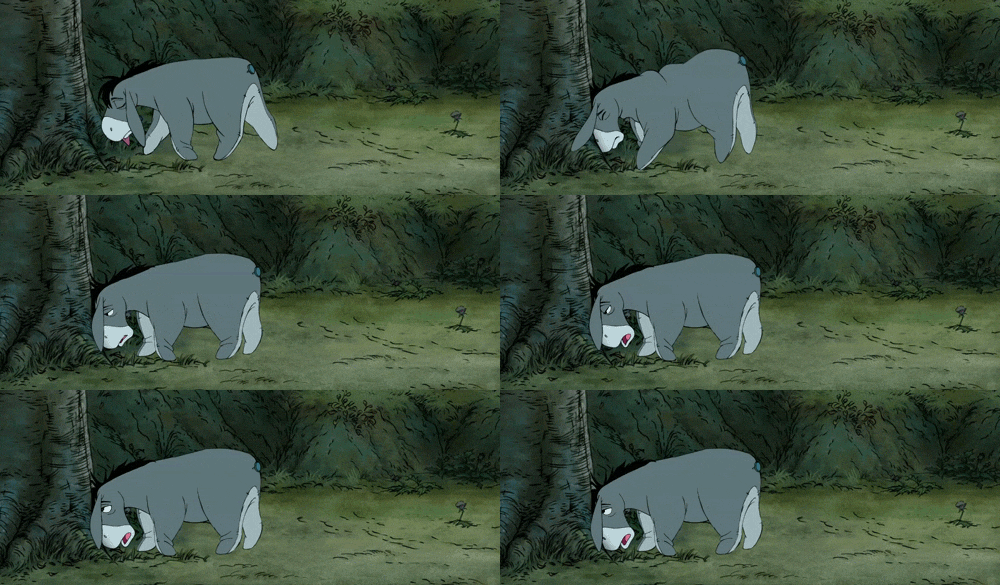
Actually, I was feeling pretty sorry for myself.


Eeyore bumping into a tree
source

Why did I even agree to give this talk? Why did I propose this topic? But then, it the midst of trying to figure out if it was too late to change my topic, I realized I wouldn’t need to.


David Tennant, as The Doctor, looking like he just figured something out
source

I remembered a conversation I had with a coworker back when I was brand new to the field myself. I don’t remember what we were discussing, other than I’d asked for advice, but I do remember that they stopped and looked away for a moment before continuing. They said, “you know what? That’s good advice for me, too. I find myself doing that a lot… giving advice I need to hear myself.”

So that’s where I am with this topic.

a picture of the Earth as seen from the moon, with the words "You are here" and "we all are."
source
I’ve done a lot of reading and a lot of soul searching. I even hosted an online chat as part of my work on #libleadgender related to work-life balance. But I don’t want this to come off sounding like “do as I say, not as I do.” I’m still trying to figure this work-life balance thing out myself, and I wanted to be upfront about it: I still need advice, too. Regardless, I have learned some things, and I want to share them with you.

The first big thing I want to discuss is embodied in another title I almost gave this talk:  "It's a Marathon, Not a Sprint: On Work Life Balance in Librarianship."

Wile E. Coyote, running
source


There's no other way to say it other than it's a long road. And sure, saying "it’s a long road" is a cliché, but it’s something I remind myself of probably on a weekly basis. Speaking of clichés, though, let’s think about this in terms of the analogy I did pick for my talk title: plants and gardening. I’m not much of a gardener, to be honest. I even managed to kill a bamboo plant, which is supposedly almost impossible to do. But I do know that planting and tending a garden is a long game. Preparing the soil, figuring out what plants work best in your climate and in the space you have, getting or growing seedlings, planting, weeding, harvesting. You need to think of your lives and jobs the same way because your careers are hopefully going to be a long road.

It’s easy enough to say this, right? But how do you put such an abstract thought into action? Well, here are my thoughts.

First, professional development. You’ve got to keep learning, or else you’re stalled. Think about this: when I was in graduate school, the hot new wireless protocol was 802.11b. By the time I graduated, we had 802.11g. So the stuff I learned in my "Computers in Libraries" class was out of date by the time I graduated. Never mind the fact that there have been 6 or 7 further protocols since then. And that’s just one small area of knowledge from one class. The skill that will serve you best in the long run is the ability to learn and adapt, and librarians are great at that despite the reputation we somehow picked up, but it has to be a conscious effort.

The good news is that you are already on top of this idea, since you’re reading a libraries and librarianship oriented blog. Even if you don't read my blog every time I publish something new, I hope you're taking time every week to pursue some professional development - reading or otherwise. I have to admit that, even though I require everyone on my staff to spend at least an hour each week working on some form of professional development, I have a hard time fitting it in myself. Easy to say, but hard to do.

Another reason why you need to take time for professional development, even if your main duty is staffing a service location like the circulation desk or the reference desk, is to give yourself a break from having to do emotional labor. For those of you who are unfamiliar with the term, it’s the part of your work performance that has to do with the emotions you display. There’s a very limited range of emotions that are appropriate for when you are working with the public, but we all have lives beyond the performance of our duties, right? It doesn't matter to some. Get into a fender bender on the way to work? Too bad, you have to at least pretend be in a good mood if you’re doing a story hour for toddlers. Get into a fight with your best friend? Better put that anger aside if you’re supposed to be leading a class of incoming freshmen through a basic introduction to information literacy. Get proposed to by the love of your life? You can't show how giddy happy you are because you need to be calm and steady if you’re staffing the reference desk for a three hour shift. But that hour of professional development you spend in your office or at your desk or in your work space, away from the public, that hour of turning everything else off in favor of reading the latest issue of College and Research Libraries or watching a webinar on conflict resolution… that’s an hour when you can just be yourself. And we all need that kind of break. Making sure you get that kind of space in your work week is crucial to being successful on the long haul.

Second, figure out your workflow.


a Rube Goldberg machine made out of legos
source

I’ve spent a lot of time researching this and developing my own workflow, but it’s not really something I can teach you because everyone will have a different version. Further, what works for you might change over time - I know it has for me. Right now, I mostly use a website called Habitica that turns my daily to do list into a role playing game. I’m a big ol' nerd, so the goofy 8 bit graphics make me smile every time I’m on the Habitica website. Another attraction of this site is that I go adventuring with a party, so any time I don’t accomplish a task, Habitica lets whatever monster we’re fighting injure the whole party. I also use a paper planner. The act of writing myself a list helps me organize the following day.

If you're trying to get a handle on your workflow, there are some things that I think everyone needs to remember:
  1. You need a way to capture ideas immediately. This can be an Evernote file or a Google doc or a box on your desk where you throw scraps of paper with things scribbled on them. Don’t trust your memory - human memories are faulty at the best of times, but when you’re under a lot of stress - like with a forever long To Do list - your brain will turn into a sieve.
  1. You need to look at your ideas on a regular basis. I try to do it weekly, but never go more than two weeks. Capturing things immediately is a way to get them out of your brain to make room for other processes, but you can’t ignore those ideas otherwise you won’t have processing room.
  1. Keep track of your accomplishments. When you’re thinking long term, sometimes smaller accomplishments fade away and all you can see is the big things you haven’t done yet. Any time I start to feel overwhelmed by everything I want to do to improve my library and the service we provide to our community, I look at the list of things I’ve already done. I wish someone had told me to do this early in my career because this, more than anything, keeps me from burning out when I feel overwhelmed.
  1. You need to learn to let go of projects. This is one of the hardest things anyone ever has to do, especially when you love what you do and really want to give the best to the community you’re serving. Sometimes it will be a project that is going well but that isn’t as successful as you’d hoped. Other times it will be a great idea that you just don’t have the money or staffing or energy to accomplish. I find prioritizing easiest when I look at my ideas and ongoing projects in light of the mission statement of both my library and my college. If your library doesn’t have a mission statement, or if it’s a long and convoluted mess of a statement, you could always look at your job description or sit down with your boss to figure out which things are most important.

The third thing you need to remember when thinking about the long haul is that work-life balance is a myth.


Mythbusters picture with the word "busted" over the picture.
source

It's never going to happen in the short term. The idea of work-life balance is a myth perpetrated to make us feel even more like failures. It’s the unicorn I was chasing when I first proposed this topic to the organizing committee. If you are tenure track or have a new position or are working on another advanced degree, of course you’re going to throw yourself into your job. That’s the way it works and in a lot of ways, it’s necessary to lose yourself in your job for at times. But there are also going to be times when you’re personal life will take over. You could get really sick - everything from a bad case of the flu to something really serious. You could get pregnant or adopt a kid, at which point you better darn well focus on that new little life. You could end up having to take care of a sick relative.

Don’t neglect your personal life completely because you can’t just be the job. But don’t feel bad about those times when you have to say no thanks to going out with friends because you have an article revision due or a grant proposal due at work. But don’t neglect. The most important thing to remember during those stretches where work seems to blot out everything is the next big theme I want to address: self care.


Treat. Yo. Self.
source

Now, let me dispense with a common misconception. Self care is not the same thing as self indulgence. During a recent #libleadgender conversation, someone expressed a concern that self care could be seen as “Treat Yo Self.” Nothing could be further from the truth. When people talk about self-care, they aren’t talking about buying themselves a movie caliber Batman costume. When people talk about self-care, they are talking about drinking enough water and taking a sick day if you have a fever. They’re literally talking about taking care of themselves.

This is another aspect that can be easier said than done, so I want to share with you some of the things I think everyone should do.


a ring tailed lemur sitting as if it is meditating
source

First, spend at least 5 to 10 minutes every single day being still and quiet. If you are religious, this can be prayer or meditation. If you aren’t religious, it can still be meditation but it can also be sitting outside. And I’m gonna say something that you might not want to hear, but watching television or listening to a podcast isn’t gonna cut it. Think about the surface of a pond after someone has thrown a pebble or a boulder or anything into it. What does it take to get the water to rest and be still? It’s not more input. I can’t even tell you how much research has been done into this idea. Really, everything I’m sharing here is based on research. This is basic self care and so beneficial.


Ren and Stimpy eating sandwiches
source

Next, take a lunch break. The occasional - like once or twice a month - lunch hour spent snarfing food at your desk while you continue to work on a big project is okay. But don’t make a habit of it. You are not doing yourself or anyone else any good if you work work work straight through. In fact, there are countless studies and articles that talk about how taking a break and letting yourself rest improves the quality of your work. If you’re more introverted, go somewhere quiet away from your office and eat lunch there. If you’re recharged by spending time with people, go to the staff room or the dining hall or to a friend’s office to eat.


sleeping black kitten
source

Here’s another one: you need to get sleep. But remember that enough sleep for one person isn’t going to be enough for someone else. I need 7 hours or else I’m cranky and shaky, although I can every once in a while survive on 5 or 6. I’m middle aged, so I’m cranky enough already. Trust me, you don’t want to see me crankier. If you’re having a hard time sleeping, whether from anxiety or other reasons, get yourself to a doctor. I went and slept overnight at a hospital a few years ago in order to figure out why I wasn’t sleeping well, and you better believe I followed every one of my doctor’s suggestions. Insomnia and lack of sleep only makes things worse, so staying up late to get more done… well, that isn’t going to cut it either.


a goat and a baby rhino playing together
source

Another thing you need to do is you need to move. Yes, I’m talking about exercise if you’re capable of it, but I’m also talking about seeing different sights or hearing different sounds. Don’t overtax yourself or think you’re not doing things right if you can’t take a walk because you have mobility issues. Even just moving to a different part of your library can help you.


30 Rock screen shot of Alec Baldwin holding a cookie jar
source
The final admonition I have about self-care is that you need to make time in your life for something that isn’t librarian related. You need a hobby or a club or other kind of activity, and reading doesn’t count because that’s still library related.

[At this point in the keynote, I asked people to discuss hobbies - something they love but have neglected and something they've always wanted to try - with the people sitting next to them, before sharing my own hobbies.]

For something I love to do, but that I haven’t done in a while, I need to admit to neglecting my guitar. I didn’t pick it up until a couple of years ago, but a couple of months back when the semester started, that 10 to 15 minutes I used to spend with my guitar went into other things instead. And for me, playing the guitar and learning a new song or new technique is bliss - even when it’s challenging. Maybe especially when it’s challenging.
And for something I want to do, I want to learn to be a better baker. I can do a few thing, like my great grandmother’s pumpkin bread recipe or pizza dough, but I really envy people who are good bakers. And more than anything else, I want to learn to make bagels. I am obsessed with bagels lately, and I end up spending so much money to get the good ones at the bakery.

a picture of me with my guitar

a classical looking painting of soldiers on horseback, with one holding a bagel
source

As for me, I will learn a new song and try a bagel recipe. Before Thanksgiving. And I’m expecting you all to hold me accountable. I’ll post that I learned the song and pictures of my bagels, and if I don’t meet the deadline, please call me out. In fact, if I don’t meet that deadline, I’ll donate $100 to a charity and I’ll let you all chose. Deal?


the cast of Firefly
source

And this leads me to my third big point: you need to have a support network. Before I get into this part, I want each of you to exchange contact information with one of the people you just talked with and pick which hobby or activity you are definitely going to do over the next month. You’re going to hold each other accountable just like I’m asking you to hold me accountable. So take a moment more to give business cards or email addresses or whatever.

A support network is how self-care and thinking long term can come together.

One way this works is with goal setting, like the one I just had you all set. So let me tell you about my best friend. She’s this amazing, strong, and kind person.


a conversation between Leslie Knope and Anne Perkins about Harry Potter
source

For those of you who know Parks & Recreation, my best friend is definitely the Anne Perkins to my Leslie Knope. I even made her watch all 8 Harry Potter movies, but luckily for me my bestie loved Harry Potter. Anyway, we have become each other’s life coaches. We meet once a week to set goals for ourselves for the next week and to check if we’ve met the goals from the previous week. If we met the goals, we get to take a nap that weekend. If we didn’t, we have to socialize with a coworker who drives us crazy. It’s making the promise to someone else, with ramifications, that gets me to keep up with the goals I set for myself.

Buffy the Vampire Slayer saying "But I have to save the world! Again!"
source

Another way this works is you have a cheering section when you start to doubt yourself. When I was new in my current position, I had a day that left me feeling worn down and wrung out. I was exhausted and feeling a little despondent because something I’d been working on for a while had gotten stalled yet again. A good friend of mine was trying to make me feel better. I told him that I couldn’t keep up my normal witty banter because I felt like Buffy Summers after she triumphed over the demon mayor, and that I was at the “fire bad; tree pretty” level of tired. My friend responded, “so what you’re saying is that on your worst day you’re still a vampire slayer?” It made me laugh, which made me feel better.

My best friend is a psychology professor and my online friend is an academic librarian who mostly focuses on technical services type stuff. But I also have a professional support network that keeps me going long term. I know so many library administrators who have mentored me or who I mentor, officially and unofficially. I can reach out to them and ask everything from how do I handle a particularly sticky situation with a faculty member, to recommendations for compressed shelving vendors, and beyond.
You need a support network and friends both within and outside of the profession, both within and outside of your particular specialty in librarianship. You need people who know exactly what you’re going through and doing, and people who have only vague knowledge. And this is the kind of work-life balance you need to achieve.

a hummingbird and some bees drinking from the same water source
source

And to bring this back to the metaphor I picked for the talk, gardening, again, support networks are like an ecosystem supporting multiple people just like a garden can support multiple kinds of life. Okay, I’ll admit it, I am beating the gardening analogy to death a bit here because I really wanted an excuse to use this picture, but you get my point.

baby flying fox getting wrapped in a blanket
source

Anyway, I want to wrap this up, so let me remind you of my main points, things I wish someone had told me when I was new in this field and an early career information professional:

  • You need to think long term and long distance. Hopefully you’ll all have long and fruitful careers, so you need to pace yourself and think beyond this moment.
  • You need to take care of yourself. Have a life outside of your career, be still once in a while, and get some rest.
  • And you need to have a support network as well as supporting others. Keep each other honest, Keep each other on task. And keep each other laughing.

Thanks again to the organizing committee and to all the conference attendees. I'm proud of how well this talk went, and I hope we all take my advice.

Thursday, September 29, 2016

Are There Any Questions? My First Month as a Full-Time Librarian, by Lauren Connolly

Hello! I’m new. New to this library, new to this state, and new to the world of full-time employment. I moved away from my native state of Delaware to the wilds of Northwest Ohio, the farthest I’ve ever lived from my family, to begin my new librarian life. I had a weekend to adjust to my temporary housing, and then my career began. That was a lot of change in a short amount of time, but surprisingly I only cried once, and luckily I was not at work during that temporary emotional overload. I count that as a major success.

I believe part of what has helped me keep it together is the fact that everyone here is kind to me. So simple, but so important. Even a job you don’t like can be made better by the people you work with; fortunately, I have a good job, and I am surrounded by great people. This is something I didn’t think about too much when I was job hunting. I’m an agreeable, non-confrontational person, and I thought I would be fine with whoever I ended up working alongside. When I received this offer, it came more than a year out from earning my MLIS, so I know the desperation that comes with a long job search: the little voice in the back of your head that convinces you any job offer is a good one, because at least you’ll be working.

Oh, just get a job?

But seriously, who you work with is important. People here smile, and say hello to me throughout the day. They asked me about my apartment search, and gave me recommendations on where to find cheap furniture. When I have a question, they don’t roll their eyes, they answer it, and then offer guidance. My office is right next to the library director’s, and it is not uncommon for me sidle over with one of my many questions. So far he hasn’t shut the door in my face, so I don’t think I’ve become too annoying… yet.

That was something I had to push myself to do in the beginning: ask questions. There have already been plenty of times when I’ve felt like I was missing something, like everyone else understood what was going on, and I was nodding and smiling and trying to keep up. I doubted my abilities as a librarian, feeling like I was simply mimicking people who actually knew what the hell was going on. 


This blog actually taught me what that feeling is: imposter syndrome. Honestly, is there any way to avoid that when you start a new job? You have this fancy title, but everything is unfamiliar. What do they expect you to know, and how soon? Whenever I feel the onslaught of self-doubt, I try to take a moment to myself and have an inner conversation that goes a little something like this:

Me: “What the hell is a widget? And a proxy server? What class did I skip where those were explained?!”
Me: “Lauren, calm down. We can figure this out.”
Me: “How?! I bet every other librarian knows what those things are, and has been working with them for years! How did I even get this job?!”
Me: “It’s going to be okay Lauren. Remember when you didn’t know what a LibGuide was? You were freaking out then too, but now not only do you know what they are, you’ve made them.”
Me: “Yeah, I guess…”
Me: “You know what you’re really good at? Learning. Anything they want you to do here, you can learn it. When they ask you about widgets that’s what you say. You’re not sure yet, but you’ll learn. We’ve been doing it for years. So calm down, and start researching.”
Me: “You’re right. I can do this.”

So that’s a glimpse inside my brain, and pretty much my thought process throughout my first month. I go through waves of stress, but recovery time is quick because of my co-workers. Plenty of people will tell you that when you start a new job it’s okay to ask questions. I’ve found it’s equally as important to find a place full of people who will answer those questions, and sometimes even thank you for asking them.


Lauren Connolly is the Online Services Librarian at the University ofFindlay. She tweets at @laurenaliciaCon, and also runs the Shafer Library social media pages (@ShaferLibrary).  [Editor’s note: And in the interest of full disclosure, Lauren used to work for me at Wesley College. I’m happy for her success, but I miss having her around my library.]

Thursday, July 16, 2015

Are Your Colleagues Dumb? Read This, by Kimberly Sweetman

When I think back over my career of almost 20 years, I can think of one or two defining moments. One in particular happened when I was about 2 years out of library school. I was living in the West Indies, 27 years old, and working as the associate director of the small library at an offshore medical school. That’s a great story in and of itself, but a story for another day. This was back in the mid ‘90s, and part of my responsibility was providing campus-wide training and support in Microsoft Office.

One day after assisting a colleague in the housing office with a spreadsheet, she turned to me and said, “you know, I used to wonder what value a young kid like you brought to the workplace, but now I know that you really know your stuff and do a good job.” This comment has stuck with me through my career. While librarianship was a second career for me as it is for many of us, I spent only a nano-second in my first career and earned my library degree in my mid-twenties. And I looked young. At a job interview about 10 years later (I still looked young then) I was asked how I deal with people assuming I’m younger and less experienced than I am. I was able to relay the story of what my housing office colleague had said and reply that my strategy has always been to be excellent at what I do.

Just as people no doubt dismissed me based on my appearance, I admit I did the same. When I first started out, I thought I was pretty hot stuff. I was bright and committed. There definitely were times I thought I was brighter and more committed than my colleagues. Sometimes I didn’t listen to them. And it’s a mistake I’ve seen repeated by lots of newly minted librarians. How about you? You’re smart. You’re energetic. You’re committed. You’re passionate. What do you think of your colleagues? Are they as smart, energetic, committed and passionate as you are? 

Diversity of perspective is essential in the workplace. Only recently (by reading Roger Martin’s The Responsibility Virus) did I realize that my choice to assume that my colleagues didn’t bring value to the discussion wasn’t just my own rash, over-inflated sense of self. Human beings are hard-wired to protect their own viewpoints and dismiss other perspectives. Roger Martin describes the four governing values that inform our actions when dealing with differing perspectives as:
  1. Win, don’t lose;
  2. Maintain control;
  3. Avoid embarrassment;
  4. Stay rational.
So, when someone offers a different perspective on something under discussion, we instinctively shift into a mode of wanting our perspective to prevail (win, don’t lose), of getting our way (control), of wanting our supported choice to be the right one at any cost (avoid embarrassment), and of staying rational to the point of being rigid. We tell ourselves that our perspective is the right perspective, and the answer we bring to the table is the right answer, which shuts us down from hearing differing viewpoints. We assume the other party is uninformed or possibly out to sabotage the organization. And we try to get others to see our way at the cost of listening to other ideas—ideas that could be really useful!

If we can alter this frame we can work with others to develop the strongest plans and ideas possible. Even opening your mind for five minutes to the possibility that others have something to contribute can change the dynamic. Rather than assuming you have all the answers, try this: actively tell yourself that although you have a lot of knowledge and understanding, you may not see or understand everything. By acknowledging that other people have different experiences that allow them to see things in different ways, you can remind yourself that their perspective will contribute to your understanding. Make your primary task accessing the collective intelligence in order to make the best choice.

The next time you are working with others to solve a problem, pause and check your mindset. Without being aware of Roger Martin’s theory, this is what my housing office colleague did. By actively reminding yourself that the perspectives of your colleagues, combined with your own, can make for stronger choices and options, you will ensure that your organization moves forward collaboratively. This benefits not only interpersonal relations in the workplace but also the plans and projects your organization carries out. Plans created with a diversity of perspectives are stronger and generally more successful. And fully thinking through an issue by weighing the contribution of everyone involved really does lead to better solutions.


After spending 20 years in library public service, Kimberly Sweetman now works as a consultant and coach helping libraries and library people to reach their goals and develop superior service through exceptional leadership. She blogs at kimberlysweetman.com and tweets as @sweetcoachcons.

Thursday, May 28, 2015

On the Job, But Not the Org Chart: Leading from a Position New to Your Library, by Rana Hutchinson Salzmann

source

As of this writing, I’m approaching the end of my first decade in librarianship. Yikes! How did that happen? I’d earned an MA in English and taught at local community colleges for a few semesters, but then I started library school in 2004. Like most of us, I took one “Library and Info Center Management” class during my library science graduate program. I can honestly say I don’t remember much from that elective. Still, I’ve spent almost ten years managing libraries of one sort or another so I want to offer a few thoughts about a scenario they didn’t cover in that management class – what to do when you find yourself in uncharted organizational territory – in a position that is brand new to your library?

Act 1: Department head at a small suburban public library

Fresh out of library school, I took a job as a department head at a small public library. The job description added electronic services responsibilities (meaning website, database, and IT liaison tasks) to the more traditional adult services department head role. I came in after the retirement of a long-serving department head and supervised full and part-time staff who were more than 20 years my senior.

From day one, I knew that tackling the age/experience issue would be key to my happiness at work. Not only was I new to this library, I was new to the field! I will admit to some trepidation as I knew it would be challenging to fill the shoes of my predecessor. Fortunately, I worked for a strong director who helped me get my footing while my department adjusted. The director was convinced that the department could do more to support the changing mission of the library and gave me opportunities to excel and flex my management muscle. I was excited to realize I wasn’t expected to fill anyone’s shoes, but to be a new kind of department head altogether.

Management textbooks will tell you that matching your department’s goals to the larger library mission is key. When you’re in new organizational territory, you need a strong guide. If you don’t have one (like your director or other immediate supervisor) in your library, find a mentor in your library association, from your library school faculty, or in a neighboring library.  

Act 2: Manager of a specialized research library at a nonprofit professional association

Everyone likes to say that librarians wear many hats. Here, I began as a traditional solo librarian within a research department, simply replacing an incumbent. Then, due to staffing changes and budget realignments, my role shifted. I remained library manager but also took on education/content development and conference planning responsibilities in another department. Finally, I ensconced myself within the IT department, adding content strategy and taxonomy to my portfolio of responsibilities. In my last years at that position, I championed an initiative that brought publications, research, education, and IT staff together to promote our association’s publications. We streamlined processes, launched an e-book publishing program, and made the case to hire new staff. In the end, I wrote my own job description and became the Manager of Content Strategy.

In a special library where you are the only MLS-holder, management is about seizing opportunities to market librarianship to non-librarians. I found success because I found moments to argue for the centrality of information management to the visibility of the organization. I got outside the library silo and looked for places to say “hey, the library can do this!” Note: If the library function is in the wrong department or silo in your organization, argue to move it (and yourself) where it can be best supported.

Act 3: Director of the library and IT at a small graduate theological school

Today, I find myself almost 18 months into directing a library that supports a graduate program that teaches our students to become community activists and liberal ministers. Once again, I came in after the retirement of a long-serving, beloved incumbent. And once again, the job description added IT responsibilities to a more traditional library director role.

As part of my orientation into this intimate academic community, I was asked to audit one semester of the first-year seminar, following along and learning with our newest students. That immersion experience (while unexpected!) was invaluable in helping me understand the environment. I saw teaching and learning in action and became familiar with the mission of the school by assuming the role of a student.

I like to say I am an information strategy ninja or maybe a chameleon: in order to lead effectively I have taken on new roles and worn the proverbial many hats. However, clarity is important as you take on new roles and manage people’s expectations. (During the first year on the job, I’m pretty sure I was called on to articulate my new role several times per week as everyone learned where to place me on the org chart.) Success in this kind of environment is a balancing act of adapting to your setting without losing sight of your (or your department’s) central goals and convictions.

Conclusion

We all know that change is difficult. Librarianship itself is a field in transition. Don’t be afraid to argue for a more central role for library and information services within your organization.  Find the right place on the organizational chart for you and your library. Take a deep breath and take a look around. You can find ways to manage change from wherever you fall on the organization chart.


Rana Hutchinson Salzmann, M.A., M.L.S., is the Director of Library and IT at Meadville Lombard Theological School (Unitarian Universalist) in Chicago. Rana is a librarian by training and information/ organizational strategist by vocation. She has worked in public, special/non-profit, and academic library management for nearly ten years and loves geeking out about new things that can benefit her library. Rana is all about: open government initiatives, copyright, community informatics, taxonomy, content strategy, grant writing, and management strategies to remove roadblocks and allow her staff to excel.