Showing posts with label Career Advice. Show all posts

Tuesday, January 22, 2019

Letter from a Mid Career Librarian to Their Younger Self

I'm 46. Of course if I had a time machine it would be a Delorean.

Yes, this is another post making good on a months old promise

This isn't exactly what Nick Schiller asked for when he said, "Letter from a young librarian to her mid-career self," but he got me thinking. I know the whole premise of this blog is advice for younger librarians, but what specific things would I tell myself if I could build a time machine and talk to my younger self at different points of my life? So here's what I've come up with:

LIS Graduate School Jessica:
Your ideas about what classes and experiences would help you in the future are all dead on - especially the idea of taking advanced cataloging, even though you know you're going to be public services - with one exception. You'll wish you'd taken the research class instead of the management class, mostly because the management class was useless but also because you're going to become interested in research later in your career.

First Professional Position Jessica:
Absorb everything your first director has to tell you. Remember how you said to yourself, "oh, so that's what I'm going to be like in my forties"? You were 100% correct. You even became a director! But you'll only have her for 6 months, so value the time with her. Also, be as respectful of the paraprofessionals as possible. You'll have a few missteps with this, and you'll learn to be better, but you'll wish you learned sooner.

Grant Writer Jessica:
You're not as bad at this job as you think you are, and your boss is actually much much worse. Your personal life has exploded, sure, but you're going to be so much happier at the other end than you ever were before. And the best part? This job is going to send you back to libraries just in time for a fantastic job that is perfect for you and you're perfect for it.

Information Literacy Coordinator Jessica:
You did this job right. You were good at trusting yourself and building relationships. Maybe reach out to Dee in Student Life sooner? The one thing you'll wish you'd done differently is to make friends with coworkers more as you go through your time at that school. Sure, you have some friends from that part of your life - even now, years later - but there are so many other lovely people at this school. You'll try to connect with those people after you leave, and in some cases you'll be successful (yes, I'm looking at you, Demetria), but it would have been so much nicer if you could have had more in person memories with them.

Brand New Library Director Jessica:
It's not you; it's them. You are not crazy (except in the more typical anxiety way), that place is. The best part of this place is how much you'll learn about yourself and libraries and every every everything. Oh, and the friendships that you have going into this job are going to be your lifeline. For instance, that weird guy, Jake, who makes you laugh sometimes is going to end up feeling like family. The most important thing I wish I could tell you is that you will survive this time in your life, and you will move onto a job and a city you love so much that it feels like home within 6 months.

And, to round this out, here's a message to future Jessica:
The biggest thing that you've learned is that you've got this - whatever "this" might be. Trust yourself and your process, and be kind to yourself when you aren't able to live up to an impossible standard. You really are doing the best you know how in every moment.


So how about you? Do you have any specific advice for your past and future selves?

Tuesday, December 4, 2018

Vocational Exhaustion

There's this thing that happens to a lot of people when they hit the mid-career. You look around and think, "is that all there is?" It's not about doubting your own skills, although I've had my share of that. There's the struggles for budget control and the struggles for respect from colleagues and the struggles for the next big idea, and then - once you get beyond all those struggles - things can start to feel old hat. Very "been there, done that, lost the t-shirt already." You ask yourself what's to be done, and yourself answers like this:


It's pretty much the polar opposite of vocational awe (and if you haven't read that excellent article yet, I suggest you stop reading this blog post and instead head over to In The Library With a Lead Pipe right now. It's okay. I'll wait.). You can see librarians/librarians for all their warts and peccadillos, for all the systemic racism and gendered nonsense. It's not burnout, per se, but it it is definitely a point at which you've run out of the optimism that propelled you into the profession and you're wondering what you'll do with the rest of your life.

I've known people who left librarianship at that point, and that was absolutely the right decision for them. I've also known people who stayed where they were and everyone else around them was made all the more miserable for their coworker's misery. When I've hit this wall (and it's happened to me multiple times - vocational exhaustion is not a one-and-done phenomenon), I had a serious talk with myself and found ways forward:
  • Is it librarianship or is it your employer? The last time I had this issue was about 5 years ago, and when I asked myself this question I realized it was definitely where I was working. I took my time and found the right new opportunity, and am so much happier now.
  • Are you putting too much of yourself into librarianship? If you've been reading my blog for even a second, you know how much I harp on the need for work/life balance and choosing librarianship over Librarianship. Spending more time with family or friends or with yourself doing something other than librarian stuff has been the right answer for me time and time again.
  • Are you focusing too much on what's left to do and ignoring your accomplishments? Wow, that to do list can be overwhelming, am I right? I've never in my 6 years of being a director been able to to argue for an increase in funding or staffing, and that kind of admission can make me feel like a failure and like change never happens. But then I look at the students who found their way to my classroom with whom I'm still in touch. I look at the collections I've built. I look at the people whose careers I helped launch.
  • When was the last time you took a real vacation? Not a weekend where I'm still checking my work email or a conference where I'm still consumed with librarianship. Time where I genuinely unplug and stare at things that aren't screens. I'm the worst at this, but I've got some time off coming up.
  • Are there really no more challenges left for you? I'm getting involved with a statewide effort to recruit the next generation of library leaders and foster the growth of people who've recently taken a step into administration, and I'm super excited about it. I'm also reaffirming my commitment to this blog and trying to get new voices to publish here. There are plenty of horizons left for me to conquer, and I bet there are horizons left for you as well.
 
How about you? For those of you who've faced this hurdle, how did you get over it? 


Credit goes to "Everything Is Awful and I'm Not Okay: questions to ask before giving up" for the form this post took; lots of credit goes to Jim DelRosso who helped me name the phenomenon; and thanks again to Fobazi Ettarh for giving us the term "vocational awe" in the first place - I never would have written this post if not for that article.

Tuesday, January 9, 2018

On Still Not Knowing Everything


Since I just closed out my first six months of my not-so-new-anymore job, I figured it was time to revisit the idea of knowing that I don't know - something I wrote about almost exactly 5 years ago as I was about to start my first job as a library administrator. My mind was boggling at all that I had to learn, and the truth is that I hadn't even imagined half of all that there was to know.

This most recent job change was easier in some ways. I made a lot of mistakes as a new library director... mostly dealing with people issues. Learning that I couldn't think aloud anymore was hard. Learning to ask questions in a way that the staff understood it really was just curiosity with no subtext was even harder. Hardest of all was learning to look at the entire context of an issue before trying to come up with a response. So starting my second job as an administrator was smoother because of all my past missteps, but that prior learning hasn't actually made it easy.

Although I'd worked at a two year institution before, I've never worked at a public institution of higher education. Further, although we are relatively small at just under 6000 FTE, this is also the biggest school that has ever employed me. Another big change is the size of the staff - I have 17 people working for me. I have learned a lot a lot a lot, but I'm still adjusting to all of this. And there is still so much more to learn.

Here's a list of what I KNOW I need to do:
  • Experience all the ins and outs of our budget cycle;
  • Sit down with as many of the rest of the faculty as possible;
  • Live through the rest of our strategic planning process and experience its ramifications;
  • Understand all of my responsibilities as they play out through the school year;
  • Get to know all the nuanced (or not so nuanced) differences between working at a small liberal arts college and a small-ish community college.

And that's just the stuff I know that I need to learn. At least once a week I learn something that I had no idea I needed to know, like how we handle email when someone leaves the institution or who to contact when I want to reserve a room in one of our new buildings. We all know, in theory at least, that we never stop learning, but it's so very different to be living it every day of my life. I love it.

Tuesday, November 28, 2017

Finding a Mentor Mid Career: The Frankenstein Approach


Recently, I was talking with a couple of friends about how hard it can be to find a mentor when you're no longer early career. When you're mid career, it's a little weird. Sure, you like where you are and what you're doing, but do you really want to stay forever? All three of us are the Head Cheese In Charge at our respective libraries, so there is no natural person to whom we can turn for mentoring. Or is there?

As I started to write a general, "Gee, I don't know either," kind of response to the email chain, I realized I did have an answer. Since I'm so new in my job (both of my friends have been in their jobs for a while), how I started and handled my first three months is still so fresh in my mind. I worked to find the perfect mentor, but I didn't. What I did instead was... for lack of a better name, let's call it The Frankenstein Approach.

What the heck do I mean by that? Well, the way I've found my mentor is to cobble together multiple mentors so that (almost) every piece I need is embodied by at least one person. I've got a couple of people I can turn to for questions about community college settings. There are a few who've been in libraries longer than I have and in administration on top of that. I have a couple who know my current institution - one who is my official mentor through the program Human Resources runs, and another who is just someone I can ask questions, and both of them are peers (all of us report directly to the provost). I have a couple of people who know western NY academia, too. Finally, I have a few peer mentors who just know me and my approach. Only piece I don't have yet is someone who knows SUNY, but I just agreed to be on a couple of committees that I'm hoping that will help me fill in that blank.

This has worked for me so far. It's like... if I have a question about how to approach money centered issues, I turn to an old boss, whereas if I'm having personnel issues I can turn to someone who was formerly an "official" mentor but who has turned into a peer. If I'm trying to wrap my head around faculty relationships or anything else related community colleges, I can turn to one of a couple of contacts who are also directors at community colleges. If it's a very specific question about a dynamic I saw at a meeting on campus, I can go to one of a couple of people I trust on campus. And if it's about where my career should go, I turn to my peer mentors.

You're never going to be able to get everything you need, mentoring-wise, from one person. That becomes even more true the further you get in your career. So, take my advice: use the Frankenstein approach. If you're really lucky, when you're done you'll be...

Tuesday, November 7, 2017

Questions to Ask When Eyeing The Captain's Chair


A friend of mine has become a prime target for headhunters looking for library director candidates, and so wrote to ask for advice. They aren't sure if they want to sit in the captain's chair just yet, but it's a possibility. So they wrote to me, asking for my opinion about questions to ask and red flags they should watch for when interviewing for library director positions. That friend is in academia, like me, so that's the bias of this blog post. If there's enough interest, I'll happily seek out a public library director to write a similar post.

  1. Do your research on the institution. I like GlassDoor.com, but if it's a small enough school they might not have a lot of ratings so also consider asking friends you trust if they know anyone who works there.
  2. Comb their website like crazy and learn everything you can about them. Especially look for their Clery report and for the things they don't say (like student/faculty ratio).
  3. See if AAUP has said anything, good or bad, about them. It's especially important to look if they've been censured.
  4. Also look to see how they are doing with their accreditation(s). Different regions report to different bodies - and the US Department of Education has a still decent website to determine who covers where. But you'll also want to look deeper, especially at professional programs. The American Bar Association visited my campus recently to look at our paralegal program.
  5. There's a big, neon warning that I ignored in the past: I didn't listen to my gut. I knew the place was bad, but I let my excitement about a move up get in the way of listening to my instincts.
  6. Make sure to ask all the normal interview questions like, "How will I know if I'm successful after the first year?" and, "What are the biggest challenges and opportunities facing the successful candidate?" but also pay attention to the questions they ask you. I've learned you can hear what they didn't like about the director who left if you think about their questions for a second. Example, "How do you institute change? How do you make your decisions about what to change?" can be code, depending on their tone, for, "We want someone who isn't going to change anything" or, "I hate it here and want you to change everything."
  7. The adverts are also going to be telling. How long is the ad? Super short is just as worrying as super long. Also, are they looking for the mythical unicorn? 
  8. Ask about the budget. How big it is and how decisions are made about what gets spent. Be sure to save this question for the appropriate person - the provost or whoever is the boss of the library director. If they won't tell you numbers, whoa that's a bad sign.
  9. Finally, look around you. Look at the people - is the group diverse, or pretty uniform? Look at the students - do you see a lot of them in the library? Do they seem happy? Look at the infrastructure - are the buildings in good repair? Is there decent parking? 

I know I'm forgetting something, but these questions and this approach helped me so very much with my most recent job search. In the past, if I'd taken the time to listen, I'd've heard the robot from Lost in Space warning me - "Danger, Jessica Olin! Danger!" But now? Now I feel like I get to ride a fire-breathing unicorn pretty much every day at work.


For those of you who are also in some sort of administrative position in libraries, what did I miss?

Tuesday, September 26, 2017

Pep Talk


I feel like I've been giving a lot of pep talks lately, and been needing them a bit, too. So many things can bring out our deepest insecurities - new jobs, new responsibilities, mistakes - that I thought it was time for me to write an all purpose pep talk. Or as all purpose as I can make it. Also, feel free to mix and match and use this guide to give your own pep talks to others.
  1. You got this. It's totally normal to feel overwhelmed by something new or big or both. In fact, I'd go so far as to say if you feel completely confident, then you're probably missing something. But you got this.
  2. You were hired and/or given this new project for a reason. You know what you're doing, and if you don't already know then you know where to go for help. That may be a plea for assistance on Twitter or Tumblr. Heck, it may be an email to another librarian that says something like, "I know you don't know how to do this thing I need to learn, but do you know anybody?" (I even get emails like that from blog readers - I always try to do my best, but I'm not always prompt about responses.)
  3. You're going to make mistakes, and that's okay. I've written about this before in a post that was specifically about new jobs, but it extends to new projects as well. Actually, it's something that people long established in their jobs and careers, with nothing new in their lives, also have to deal with. Mistakes happne.
  4. You will recover from bad stuff. Even if it is/was your fault. I promise. It may take a while, or no time at all, but you will recover. I've been fired before and it didn't end me. It was a restaurant job that I hated anyway, but it was still a bit of a nightmare at the time. I found another restaurant job where I made less, but took some student loans to help pay for my last classes and actually ended up finishing my MLIS sooner. I'm not trying to say that bad stuff happens for good reasons - just that getting fired wasn't the end of me.
  5. When you talk to yourself about the thing that's happening in your life, imagine you're talking to a beloved friend instead. No matter how many good things people say to you, you still need to think about how you talk to yourself about whatever it is that's happening. Would you tell a good friend with a new job that their new employer made a mistake? NO! You'd say things like, "take a deep breath and make lists of things you need to learn." Would you berate your bestie for making a mistake? NO! You'd tell them, "yeah, that was a mistake, but how can I help you to recover from it?"
  6. You got this. Yes, I'm repeating myself, but this one is the most important part of the list. There's a cliched old saying - something like, "the only true failure is giving up." (It's not applicable to 100% of situations, because sometimes you need to make strategic retreats or give up on one thing to give another the attention it deserves.) It's a good rule of thumb. We make mistakes; we get overwhelmed; but we keep trying. 

Tuesday, September 12, 2017

Tell Me About Yourself: How to Handle the Dreaded Elevator Speech


It's something I've heard so many times and kind of thought was bunk - that you need to have an elevator speech ready to go whenever you meet someone who could help your career and/or has power over your job. But as I've been introduced to different parts of my new community, I realized that the "bunk" of elevator speeches isn't that you need to have one - it's thinking that you need just one.

This all came to a head last night as I was introducing myself to our board of trustees, who are essentially my boss' boss' bosses. They have hella power over my building, my department, and my job. When I spoke to that group, I talked a little about my previous job and how I came to be here, but focused more on why I'm happy to be at my new job. "I've been nothing but impressed with this school since the moment I came for my interview all the way to today." On the other hand, when I've had get-to-know-each-other meetings with peers like deans and associate deans and similar, I've spoken more about my passion for student success and spent more time talking about my education. Another group I've spent time with recently is peers at nearby libraries. With them, I spend a lot more time talking about my path to my current job and have even been talking about leadership training I've done.

What I'm doing in each instance is establishing my credibility.

Here is how I decide what to say to whom - I...
  • Ask myself, "who is this person to me?" If they are a possible partner it's a very different speech from how I'd speak to someone who might be working for me, and both of those are very different from how I introduce myself to people who have power over my budget. 
  • Highlight appropriate accomplishments. The fact that I've been a librarian for 14+ years or my second master's degree might be important, but other times it will be the path I took to an administration job. If you're newer to the field, it might be a project you accomplished in your graduate program or the particular focus you took with your classes.
  • Keep it as short as possible while still getting across needed information. With the BoT, there had been time to mingle before the actual meeting started, so I was able to abbreviate my introduction to about a minute. When I attended a meeting of all the math, science, and career education faculty...? It was five minutes.
  • Make it stick. A good turn of phrase will take you so far with these things. One I've used over and over again, because it's so true of me, is, "I'm persistently cheerful, but also cheerfully persistent." It captures, in seven words, a main tenet of my approach to librarianship. It's not to say that I never get mad or anxious, but that over all I can turn on the happy face. Also, I am stubborn when I have an idea I want to see in action.
  • Make it resonate. When I can do a little recon about someone ahead of time, I try to figure out what works best with that person or group. Sometimes numbers works best, other times stories. Smiling and positivity work with almost everyone.

I can come up with these things mostly off the top of my head at this point in my career, but thinking on my feet and being able to communicate clearly are two of my biggest strengths. Don't be afraid to practice these things with peers or even with close friends (who will be willing to give you honest feedback). One of the first questions you get asked in every single interview process is, "Tell me about yourself," and you want to be ready.

Thursday, July 20, 2017

When Opportunity Knocks, or A Young Librarian’s Guide to Community College Librarianship, by Monique K. Clark

source
If you decide to make the leap, you might discover that a community college library is  the place for you. They combine the best of academic and public libraries, yet offer a unique environment that reflect value we hold dear as librarians. You never know what each day might bring and which one of your awesome talents might be called into action to help a patron, solve a problem, or come up with ideas to improve your library, your college, and ultimately, your community.


If you’re just starting your career as a librarian or you’re thinking of making a change, community college libraries might be the place for you. Community colleges address social issues that librarians support such as diversity, inclusion, and open access. They provide access to education for people of all backgrounds by offering classes that people need to meet their lifelong learning needs. As a result, community colleges tend to be very diverse in terms of the social, economic, racial, educational, and national background of the students and staff. However, this also means that community college libraries face unique challenges in meeting patron needs and supporting the institution's mission-- for example, ideas and strategies that work well at a four year college library or a public library won’t always be successful at a community college library. Librarians who thrive in a two-year setting must learn or strengthen skills that will help them serve our patrons and contribute to the college’s mission--attributes which can be useful in other contexts. Community college libraries are an excellent place for new librarians to develop skills such as teaching, collaboration, and management.

Although I’m no longer at one, it was a great way for me to start my career - even though it was mostly by accident. I didn’t initially plan to work at a community college, but like most people nearing the end of library school, I needed a job to pay the bills and I was lucky enough to land a full-time library specialist position at Northern Virginia Community College (NOVA) one month before graduation. Six months later, the library director encouraged me to apply for a library technology specialist position that had become vacant due to a promotion. I worked as a technology specialist for nearly three years and then I applied for and received a job offer for a campus library manager position at Central Piedmont Community College in Charlotte, NC. The knowledge and skills that I gained at both places are integral to my work at a public university and I learned to keep an open mind when new opportunities become available.

The community college environment offers many opportunities to learn new skills and collaborate with people within and outside of the library. Community colleges libraries are insanely busy in the fall, slightly less so in the spring, and even slower in the summer. During the academic year, all hands are on deck which means that you may have shifts at both the reference and circulation desk (depending on your library’s policies) or you may be asked to do a variety of tasks such as shelf reading, selecting materials to purchase, teaching a one-shot class, fixing uncooperative printers, or serving on a committee within the library or elsewhere. Flexibility, a willingness to pitch in where needed, and a great deal of patience are essential to the overall function of a library; it’s also a great way to learn about other library roles and to gain skills in those areas. Committee work can offer another perspective on the library and its relationship to the parent institution. For instance, hiring committees aren’t everyone’s cup of tea, but as a result of volunteering for so many committees, I learned a lot about applying for jobs, interviewing, hiring, and institutional values.   

In community college libraries, the summer is an ideal time to work on new or existing projects, do committee work, try new ideas, or engage in professional development activities such as attending conferences or taking classes. At NOVA, we piloted a single service point for reference and circulation interactions, something that couldn’t have happened during the academic year due to heavy foot traffic in the library. At CPCC, I co-chaired a strategic planning subcommittee which allowed me to work with my colleagues in the library and other departments to meet student needs, promote the library as place of learning and collaboration, and contribute to institutional success. If career progression is your goal, taking on projects and actively participating in committee work can be a good way to showcase your talents and demonstrate your value to the library.

Working at a community college can sometimes lead you to unexpected places. I told myself that there were certain things I would never do, but ended up doing them anyway thanks to working at a community college. I remember a comment I made to the library director at NOVA about how I would never want to be a manager. A year or so after having that conversation, I ended up applying to (and being selected for) a position at another community college that involved managing a small regional campus library and two part-time employees. Being open to taking on new responsibilities can be the push you need to challenge yourself and to flourish as a librarian.


Monique Clark is currently a reference and instruction librarian at the University of Baltimore. Prior to that, she spent five years working at two large community colleges on the East Coast. She can be found on Twitter at @wizardinglib.


Editor's note: this post presents one person's experience with working in community colleges. For other people, community colleges are their end goal. Personally, I recently moved from a small, liberal arts college to a community college. The point of this post is to encourage librarians new to the field to be open to all opportunities.

Tuesday, May 2, 2017

How I Lead


Donna Lanclos published a short piece yesterday about being a leader. It's a great. short read if you have time to read it. In it she talks a bit about the JISC Digital Leaders program, and says that during the program she "will be resisting any requests for to-do lists, or top-tips around practice." And while I agree that approach is sound, I'm still going to offer a list of things I've learned - some of them the hard way.

Here are some leadership traits and behaviors that I think should be universal:

  • You should have responsive leadership/management style. This is my phrase for how I describe adapting my style to the needs/strengths of each member of my staff. There is no one size fits all way to lead and manage. You'll have people who are amazingly self-directed and you pretty much just need to get out of their way, with occasional check ins. You'll have people who *think* they're amazing, but they aren't, so you'll have to keep them focused without killing their enthusiasm. You'll have people who have been treated badly in the past and you'll need to help them find their enthusiasm again. You need to tailor your management style to each person.
  • I've talked about this before, but you need to be able to admit mistakes. You're going to make them. It happens. I made a joke that someone took seriously, and I was absolutely mortified later when I realized what I'd done. I apologized and we found a way forward, but it all started when I admitted the mistake.
  • It's all well and good building consensus and getting people on board, but sometimes you're going to have to be able to make unpopular decisions. Maybe it will be money. Maybe it will be lack of personnel. Maybe it will be something coming down from administration. Maybe you'll even have to fire someone. I'm as transparent as possible, explaining everything that leads up to a decision. And let me tell you - this was a hard lesson to learn.
  • Another hard lesson was learning to own my strengths and weaknesses. I cannot be all things to all people, but I tried at first. I really tried. I cannot recommend the Gallup Strengths Quest enough for this, because not only did it help me understand my strengths but it also gave my staff a common vocabulary.
  • One thing that wasn't as hard for me was being able to handle change. Yes, I'm kind of talking about this in a generic "things always change" kind of way, but I'm also talking about change as in a specific "people move on" kind of way. At my current library, there are only two full time employees - and I'm one of them. Everyone else who works here is a part time employee, which means no benefits and no more than 29 hours per week. And that means I have a fair amount of turnover. Is it inconvenient when people move on in the middle of the semester and leave me scrambling? Sure it is. But it doesn't mean I take it personally. In fact, I've helped more than one person in my employ find a better gig when it was better for them.
  • This phrasing comes from Jake Berg, but it's so important: the chain of yelling goes up, not down. It's not that you'll never correct people (I wrote about that previously), but when things go wrong I take the blame and if it's not my fault it goes up the ladder. 
  • Your most important duty as a manager and leader is to run interference so your people can get shiz done. That's why I picked the gif above to accompany this post - it's the thing I spend most of my time doing. Making things easier for our students and for our faculty, for the staff outside of this department and most especially for the staff inside of this department. One thing from Lanclos' post that really stuck with me was the title of her post: "Being a Leader Isn't About You." The reasons I became a library director are complicated, but I always knew it wouldn't be about me once I got in the captain's chair - and I was right.


If you're considering moving into a leadership role, whether it's leading from the middle or from an administrative role, you have to be yourself - but be the best version of yourself. The things I put in that list are general qualities and skills, but I really believe they make me a better leader. That and the fact that I never give up trying to improve.

Tuesday, November 15, 2016

Nothing Blooms Every Day: On Work Life Balance in Librarianship (My RECIP/CLRC Keynote)

Below you'll find something approximating the keynote talk I gave a couple of weeks ago at RECIP/CLRC. It's mostly what I wrote ahead of time, with a little bit of my memory of what I said instead. Also, I had a mini-breakout session in the middle of the talk and have tweaked what I wrote to fit this context. Thanks for reading.


Before I get into the meat of my talk, I want to thank Tyler Dzuba and the rest of the conference organizers for inviting me here today. One of the driving passions in my career is helping library science graduate students and early career information professionals, so this conference’s raison d’etre is very near and dear to my heart. On top of that, what a gorgeous time of year to be this far north. Delaware trees have started to turn, but nothing like what I saw on my drive up.

I have one more thing I want to tell you up front... a caveat of sorts, if you will.

warning sign with human figure falling off a cliff
source

You see, even though I knew my topic for this talk almost immediately, I had a hard time writing it. When the organizing committee approached me, I’d been doing a lot of reading related to this topic and expected to have a good handle on it by the time the conference rolled around. That just didn’t happen, and I felt stumped.

Whenever I’ve given presentations or workshops or whatever in the past, whether invited or proposed, I was always coming from a place of knowledge. I was the one saying, “hi, I did a thing, and you should let me teach you how to do a thing.” But that just isn’t true here. The reason I’d been researching this is because I was having problems myself. In fact, one of the ideas I had for the title of this talk was “Learn From My Mistakes: On Work Life Balance in Librarianship.”

a raccoon stuck face first in a recycling bin
source

I've made lots of mistakes in this way, and the reality is that I’ll likely always have problems. So there I was, someone supposedly so knowledgeable that I was invited to give a keynote. Yet I was at a loss.

Actually, I was feeling pretty sorry for myself.


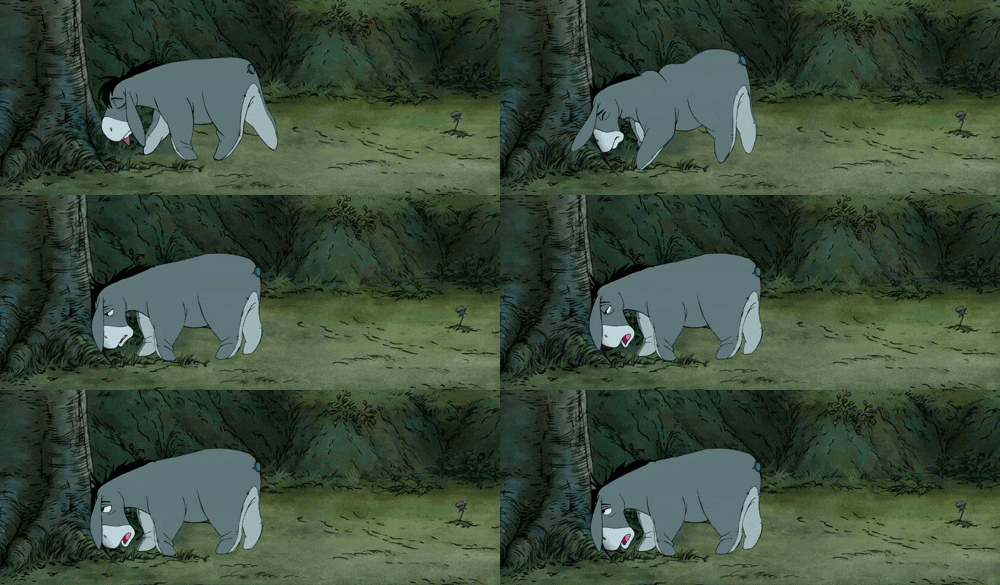
Eeyore bumping into a tree
source

Why did I even agree to give this talk? Why did I propose this topic? But then, it the midst of trying to figure out if it was too late to change my topic, I realized I wouldn’t need to.


David Tennant, as The Doctor, looking like he just figured something out
source

I remembered a conversation I had with a coworker back when I was brand new to the field myself. I don’t remember what we were discussing, other than I’d asked for advice, but I do remember that they stopped and looked away for a moment before continuing. They said, “you know what? That’s good advice for me, too. I find myself doing that a lot… giving advice I need to hear myself.”

So that’s where I am with this topic.

a picture of the Earth as seen from the moon, with the words "You are here" and "we all are."
source
I’ve done a lot of reading and a lot of soul searching. I even hosted an online chat as part of my work on #libleadgender related to work-life balance. But I don’t want this to come off sounding like “do as I say, not as I do.” I’m still trying to figure this work-life balance thing out myself, and I wanted to be upfront about it: I still need advice, too. Regardless, I have learned some things, and I want to share them with you.

The first big thing I want to discuss is embodied in another title I almost gave this talk:  "It's a Marathon, Not a Sprint: On Work Life Balance in Librarianship."

Wile E. Coyote, running
source


There's no other way to say it other than it's a long road. And sure, saying "it’s a long road" is a cliché, but it’s something I remind myself of probably on a weekly basis. Speaking of clichés, though, let’s think about this in terms of the analogy I did pick for my talk title: plants and gardening. I’m not much of a gardener, to be honest. I even managed to kill a bamboo plant, which is supposedly almost impossible to do. But I do know that planting and tending a garden is a long game. Preparing the soil, figuring out what plants work best in your climate and in the space you have, getting or growing seedlings, planting, weeding, harvesting. You need to think of your lives and jobs the same way because your careers are hopefully going to be a long road.

It’s easy enough to say this, right? But how do you put such an abstract thought into action? Well, here are my thoughts.

First, professional development. You’ve got to keep learning, or else you’re stalled. Think about this: when I was in graduate school, the hot new wireless protocol was 802.11b. By the time I graduated, we had 802.11g. So the stuff I learned in my "Computers in Libraries" class was out of date by the time I graduated. Never mind the fact that there have been 6 or 7 further protocols since then. And that’s just one small area of knowledge from one class. The skill that will serve you best in the long run is the ability to learn and adapt, and librarians are great at that despite the reputation we somehow picked up, but it has to be a conscious effort.

The good news is that you are already on top of this idea, since you’re reading a libraries and librarianship oriented blog. Even if you don't read my blog every time I publish something new, I hope you're taking time every week to pursue some professional development - reading or otherwise. I have to admit that, even though I require everyone on my staff to spend at least an hour each week working on some form of professional development, I have a hard time fitting it in myself. Easy to say, but hard to do.

Another reason why you need to take time for professional development, even if your main duty is staffing a service location like the circulation desk or the reference desk, is to give yourself a break from having to do emotional labor. For those of you who are unfamiliar with the term, it’s the part of your work performance that has to do with the emotions you display. There’s a very limited range of emotions that are appropriate for when you are working with the public, but we all have lives beyond the performance of our duties, right? It doesn't matter to some. Get into a fender bender on the way to work? Too bad, you have to at least pretend be in a good mood if you’re doing a story hour for toddlers. Get into a fight with your best friend? Better put that anger aside if you’re supposed to be leading a class of incoming freshmen through a basic introduction to information literacy. Get proposed to by the love of your life? You can't show how giddy happy you are because you need to be calm and steady if you’re staffing the reference desk for a three hour shift. But that hour of professional development you spend in your office or at your desk or in your work space, away from the public, that hour of turning everything else off in favor of reading the latest issue of College and Research Libraries or watching a webinar on conflict resolution… that’s an hour when you can just be yourself. And we all need that kind of break. Making sure you get that kind of space in your work week is crucial to being successful on the long haul.

Second, figure out your workflow.


a Rube Goldberg machine made out of legos
source

I’ve spent a lot of time researching this and developing my own workflow, but it’s not really something I can teach you because everyone will have a different version. Further, what works for you might change over time - I know it has for me. Right now, I mostly use a website called Habitica that turns my daily to do list into a role playing game. I’m a big ol' nerd, so the goofy 8 bit graphics make me smile every time I’m on the Habitica website. Another attraction of this site is that I go adventuring with a party, so any time I don’t accomplish a task, Habitica lets whatever monster we’re fighting injure the whole party. I also use a paper planner. The act of writing myself a list helps me organize the following day.

If you're trying to get a handle on your workflow, there are some things that I think everyone needs to remember:
  1. You need a way to capture ideas immediately. This can be an Evernote file or a Google doc or a box on your desk where you throw scraps of paper with things scribbled on them. Don’t trust your memory - human memories are faulty at the best of times, but when you’re under a lot of stress - like with a forever long To Do list - your brain will turn into a sieve.
  1. You need to look at your ideas on a regular basis. I try to do it weekly, but never go more than two weeks. Capturing things immediately is a way to get them out of your brain to make room for other processes, but you can’t ignore those ideas otherwise you won’t have processing room.
  1. Keep track of your accomplishments. When you’re thinking long term, sometimes smaller accomplishments fade away and all you can see is the big things you haven’t done yet. Any time I start to feel overwhelmed by everything I want to do to improve my library and the service we provide to our community, I look at the list of things I’ve already done. I wish someone had told me to do this early in my career because this, more than anything, keeps me from burning out when I feel overwhelmed.
  1. You need to learn to let go of projects. This is one of the hardest things anyone ever has to do, especially when you love what you do and really want to give the best to the community you’re serving. Sometimes it will be a project that is going well but that isn’t as successful as you’d hoped. Other times it will be a great idea that you just don’t have the money or staffing or energy to accomplish. I find prioritizing easiest when I look at my ideas and ongoing projects in light of the mission statement of both my library and my college. If your library doesn’t have a mission statement, or if it’s a long and convoluted mess of a statement, you could always look at your job description or sit down with your boss to figure out which things are most important.

The third thing you need to remember when thinking about the long haul is that work-life balance is a myth.


Mythbusters picture with the word "busted" over the picture.
source

It's never going to happen in the short term. The idea of work-life balance is a myth perpetrated to make us feel even more like failures. It’s the unicorn I was chasing when I first proposed this topic to the organizing committee. If you are tenure track or have a new position or are working on another advanced degree, of course you’re going to throw yourself into your job. That’s the way it works and in a lot of ways, it’s necessary to lose yourself in your job for at times. But there are also going to be times when you’re personal life will take over. You could get really sick - everything from a bad case of the flu to something really serious. You could get pregnant or adopt a kid, at which point you better darn well focus on that new little life. You could end up having to take care of a sick relative.

Don’t neglect your personal life completely because you can’t just be the job. But don’t feel bad about those times when you have to say no thanks to going out with friends because you have an article revision due or a grant proposal due at work. But don’t neglect. The most important thing to remember during those stretches where work seems to blot out everything is the next big theme I want to address: self care.


Treat. Yo. Self.
source

Now, let me dispense with a common misconception. Self care is not the same thing as self indulgence. During a recent #libleadgender conversation, someone expressed a concern that self care could be seen as “Treat Yo Self.” Nothing could be further from the truth. When people talk about self-care, they aren’t talking about buying themselves a movie caliber Batman costume. When people talk about self-care, they are talking about drinking enough water and taking a sick day if you have a fever. They’re literally talking about taking care of themselves.

This is another aspect that can be easier said than done, so I want to share with you some of the things I think everyone should do.


a ring tailed lemur sitting as if it is meditating
source

First, spend at least 5 to 10 minutes every single day being still and quiet. If you are religious, this can be prayer or meditation. If you aren’t religious, it can still be meditation but it can also be sitting outside. And I’m gonna say something that you might not want to hear, but watching television or listening to a podcast isn’t gonna cut it. Think about the surface of a pond after someone has thrown a pebble or a boulder or anything into it. What does it take to get the water to rest and be still? It’s not more input. I can’t even tell you how much research has been done into this idea. Really, everything I’m sharing here is based on research. This is basic self care and so beneficial.


Ren and Stimpy eating sandwiches
source

Next, take a lunch break. The occasional - like once or twice a month - lunch hour spent snarfing food at your desk while you continue to work on a big project is okay. But don’t make a habit of it. You are not doing yourself or anyone else any good if you work work work straight through. In fact, there are countless studies and articles that talk about how taking a break and letting yourself rest improves the quality of your work. If you’re more introverted, go somewhere quiet away from your office and eat lunch there. If you’re recharged by spending time with people, go to the staff room or the dining hall or to a friend’s office to eat.


sleeping black kitten
source

Here’s another one: you need to get sleep. But remember that enough sleep for one person isn’t going to be enough for someone else. I need 7 hours or else I’m cranky and shaky, although I can every once in a while survive on 5 or 6. I’m middle aged, so I’m cranky enough already. Trust me, you don’t want to see me crankier. If you’re having a hard time sleeping, whether from anxiety or other reasons, get yourself to a doctor. I went and slept overnight at a hospital a few years ago in order to figure out why I wasn’t sleeping well, and you better believe I followed every one of my doctor’s suggestions. Insomnia and lack of sleep only makes things worse, so staying up late to get more done… well, that isn’t going to cut it either.


a goat and a baby rhino playing together
source

Another thing you need to do is you need to move. Yes, I’m talking about exercise if you’re capable of it, but I’m also talking about seeing different sights or hearing different sounds. Don’t overtax yourself or think you’re not doing things right if you can’t take a walk because you have mobility issues. Even just moving to a different part of your library can help you.


30 Rock screen shot of Alec Baldwin holding a cookie jar
source
The final admonition I have about self-care is that you need to make time in your life for something that isn’t librarian related. You need a hobby or a club or other kind of activity, and reading doesn’t count because that’s still library related.

[At this point in the keynote, I asked people to discuss hobbies - something they love but have neglected and something they've always wanted to try - with the people sitting next to them, before sharing my own hobbies.]

For something I love to do, but that I haven’t done in a while, I need to admit to neglecting my guitar. I didn’t pick it up until a couple of years ago, but a couple of months back when the semester started, that 10 to 15 minutes I used to spend with my guitar went into other things instead. And for me, playing the guitar and learning a new song or new technique is bliss - even when it’s challenging. Maybe especially when it’s challenging.
And for something I want to do, I want to learn to be a better baker. I can do a few thing, like my great grandmother’s pumpkin bread recipe or pizza dough, but I really envy people who are good bakers. And more than anything else, I want to learn to make bagels. I am obsessed with bagels lately, and I end up spending so much money to get the good ones at the bakery.

a picture of me with my guitar

a classical looking painting of soldiers on horseback, with one holding a bagel
source

As for me, I will learn a new song and try a bagel recipe. Before Thanksgiving. And I’m expecting you all to hold me accountable. I’ll post that I learned the song and pictures of my bagels, and if I don’t meet the deadline, please call me out. In fact, if I don’t meet that deadline, I’ll donate $100 to a charity and I’ll let you all chose. Deal?


the cast of Firefly
source

And this leads me to my third big point: you need to have a support network. Before I get into this part, I want each of you to exchange contact information with one of the people you just talked with and pick which hobby or activity you are definitely going to do over the next month. You’re going to hold each other accountable just like I’m asking you to hold me accountable. So take a moment more to give business cards or email addresses or whatever.

A support network is how self-care and thinking long term can come together.

One way this works is with goal setting, like the one I just had you all set. So let me tell you about my best friend. She’s this amazing, strong, and kind person.


a conversation between Leslie Knope and Anne Perkins about Harry Potter
source

For those of you who know Parks & Recreation, my best friend is definitely the Anne Perkins to my Leslie Knope. I even made her watch all 8 Harry Potter movies, but luckily for me my bestie loved Harry Potter. Anyway, we have become each other’s life coaches. We meet once a week to set goals for ourselves for the next week and to check if we’ve met the goals from the previous week. If we met the goals, we get to take a nap that weekend. If we didn’t, we have to socialize with a coworker who drives us crazy. It’s making the promise to someone else, with ramifications, that gets me to keep up with the goals I set for myself.

Buffy the Vampire Slayer saying "But I have to save the world! Again!"
source

Another way this works is you have a cheering section when you start to doubt yourself. When I was new in my current position, I had a day that left me feeling worn down and wrung out. I was exhausted and feeling a little despondent because something I’d been working on for a while had gotten stalled yet again. A good friend of mine was trying to make me feel better. I told him that I couldn’t keep up my normal witty banter because I felt like Buffy Summers after she triumphed over the demon mayor, and that I was at the “fire bad; tree pretty” level of tired. My friend responded, “so what you’re saying is that on your worst day you’re still a vampire slayer?” It made me laugh, which made me feel better.

My best friend is a psychology professor and my online friend is an academic librarian who mostly focuses on technical services type stuff. But I also have a professional support network that keeps me going long term. I know so many library administrators who have mentored me or who I mentor, officially and unofficially. I can reach out to them and ask everything from how do I handle a particularly sticky situation with a faculty member, to recommendations for compressed shelving vendors, and beyond.
You need a support network and friends both within and outside of the profession, both within and outside of your particular specialty in librarianship. You need people who know exactly what you’re going through and doing, and people who have only vague knowledge. And this is the kind of work-life balance you need to achieve.

a hummingbird and some bees drinking from the same water source
source

And to bring this back to the metaphor I picked for the talk, gardening, again, support networks are like an ecosystem supporting multiple people just like a garden can support multiple kinds of life. Okay, I’ll admit it, I am beating the gardening analogy to death a bit here because I really wanted an excuse to use this picture, but you get my point.

baby flying fox getting wrapped in a blanket
source

Anyway, I want to wrap this up, so let me remind you of my main points, things I wish someone had told me when I was new in this field and an early career information professional:

  • You need to think long term and long distance. Hopefully you’ll all have long and fruitful careers, so you need to pace yourself and think beyond this moment.
  • You need to take care of yourself. Have a life outside of your career, be still once in a while, and get some rest.
  • And you need to have a support network as well as supporting others. Keep each other honest, Keep each other on task. And keep each other laughing.

Thanks again to the organizing committee and to all the conference attendees. I'm proud of how well this talk went, and I hope we all take my advice.